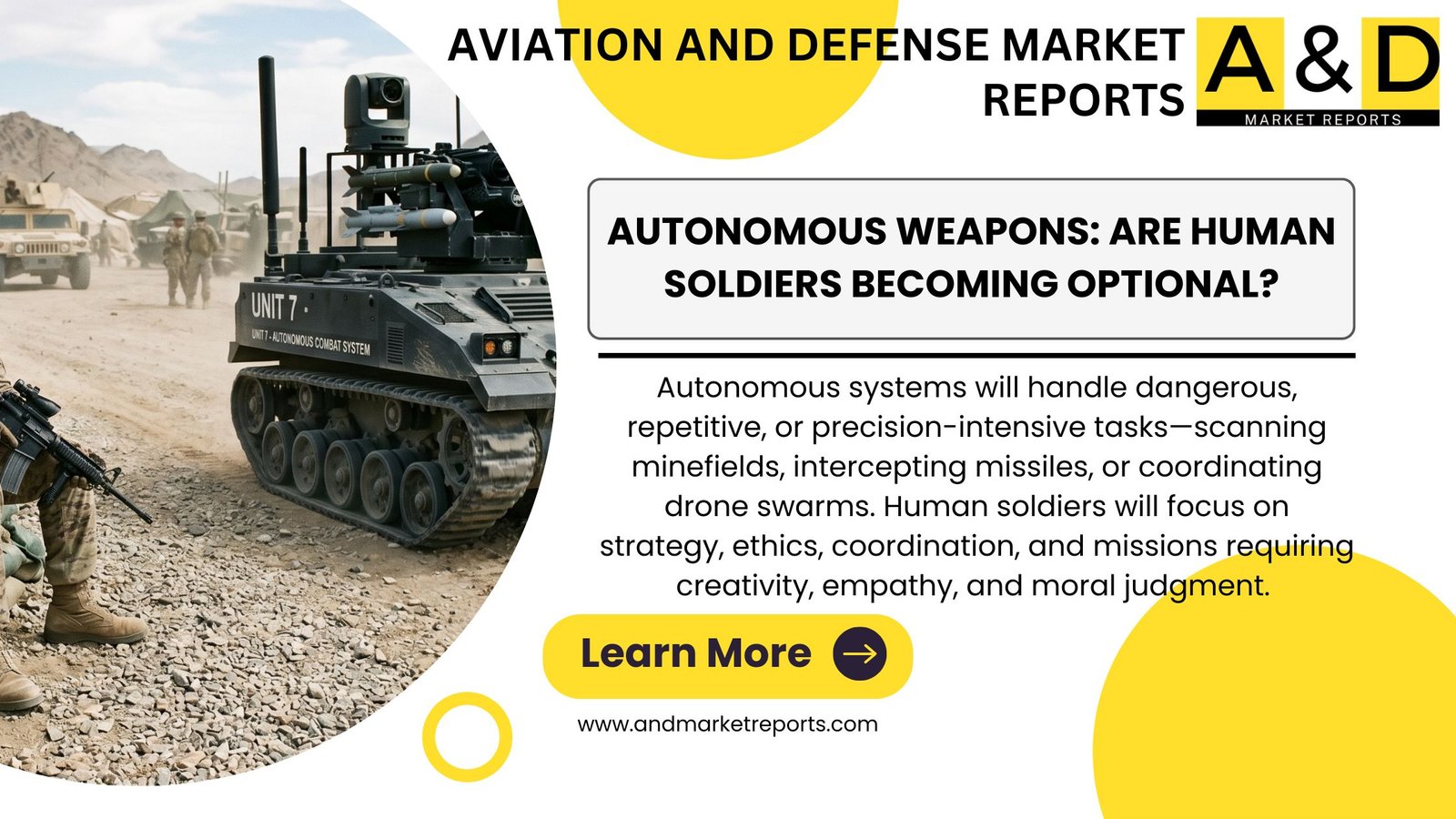

The battlefield is undergoing a quiet revolution. Drones that swarm like insects, tanks that navigate without drivers, and missile systems that select targets without human approval are no longer science fiction. Autonomous weapons systems—machines capable of identifying, tracking, and engaging targets without real-time human intervention—are reshaping warfare faster than most policymakers anticipated. This rapid evolution forces a critical question: Are human soldiers becoming optional on future battlefields?
The answer is not a simple yes or no. While autonomous systems are increasingly capable, the future of warfare will likely hinge on a hybrid model where human soldiers and autonomous weapons coexist, each amplifying the other’s strengths rather than replacing them entirely.
The Rise of Autonomous Warfare
Autonomous weapons span a spectrum from semi-autonomous systems requiring human authorization to fully autonomous platforms making independent lethal decisions. Modern examples include loitering munitions that circle battlefields searching for targets, air defense systems that intercept incoming missiles in milliseconds, and robotic scouts that infiltrate enemy territory without risking human lives.
The military advantages are undeniable. Machines process information faster than humans, react without hesitation, and operate continuously without fatigue. They can coordinate in swarms, overwhelming defenses through sheer numbers. They do not feel fear, pain, or moral doubt—traits that can be both an asset and a liability in combat.
Iceland became the first nation to ban lethal autonomous weapons, reflecting growing global concern. Yet major powers continue advancing these capabilities, driven by the strategic imperative to outpace adversaries in speed and precision.
The Human Element: Why Soldiers Remain Irreplaceable
Despite technological advances, human soldiers bring irreplaceable qualities to warfare. Judgment, moral reasoning, and adaptability in chaotic environments remain uniquely human traits. Autonomous systems excel in structured scenarios but struggle with the fog of war—unexpected variables, civilian presence, and ethical gray zones that demand nuanced decisions.
Consider a drone detecting movement in a residential area. Is it an enemy combatant or a civilian fleeing danger? A machine can identify shapes but cannot understand context, intent, or the weight of a life-or-death decision. Humans exercise discretion, weigh consequences, and bear moral responsibility—dimensions that algorithms cannot fully replicate.
Furthermore, soldiers embody the political and ethical legitimacy of military force. Nations deploy armed forces to protect citizens, uphold values, and represent national will. Fully autonomous warfare risks delegating life-and-death decisions to code, raising profound ethical questions about accountability and the very nature of war.
The Hybrid Future: Soldiers and Machines as Equals
The most promising future lies not in choosing between humans and machines but in integrating them into cohesive teams. Human-soldier systems augmented by autonomous weapons create synergies neither could achieve alone. Soldiers provide moral compass, strategic judgment, and contextual awareness. Autonomous systems deliver speed, precision, endurance, and scale.
In this hybrid model, soldiers command swarms of drones that scout ahead, neutralize threats at range, and absorb casualties without loss of human life. Autonomous logistics vehicles resupply forward units silently. AI-powered intelligence systems process satellite imagery and intercept communications, highlighting threats for human operators to act upon.
Tactical vests embedded with sensors monitor soldier health and transmit real-time location data. Exoskeletons amplify strength, allowing soldiers to carry heavier loads over longer distances. Augmented reality helmets overlay battlefield data, marking friend and foe instantly. The soldier remains the center of decision-making, but their capabilities are exponentially amplified by technology.
Ethical and Strategic Imperatives
The integration of autonomous weapons demands rigorous ethical frameworks. International humanitarian law requires distinction between combatants and civilians, proportionality in force use, and accountability for violations. Fully autonomous systems must comply with these principles, but current technology cannot guarantee compliance in complex scenarios.
Human oversight remains essential. Soldiers must retain the ability to override autonomous systems, abort missions, and intervene when circumstances shift unexpectedly. The concept of “meaningful human control” ensures that lethal decisions remain grounded in human judgment and moral responsibility.
Strategically, over-reliance on autonomous systems creates vulnerabilities. Adversaries can jam communication links, spoof sensors, or hack software. Human soldiers provide redundancy, adaptability, and resilience when technology fails. A hybrid force remains dangerous even when networks are disrupted.
The Path Forward: Augmentation Over Replacement
The future of warfare will not eliminate human soldiers but will transform what they do and how they fight. The most effective militaries will be those that successfully integrate autonomous weapons into human-centric force structures, treating machines as force multipliers rather than replacements.
Autonomous systems will handle dangerous, repetitive, or precision-intensive tasks—scanning minefields, intercepting missiles, or coordinating drone swarms. Human soldiers will focus on strategy, ethics, coordination, and missions requiring creativity, empathy, and moral judgment. Together, they form a lethal, adaptable, and ethically grounded force.
This integration demands investment in training, doctrine, and technology. Soldiers must learn to command autonomous systems as effectively as they handle weapons. Engineers must design systems that prioritize transparency, reliability, and human oversight. Policymakers must establish rules of engagement that balance innovation with accountability.
Conclusion: A Shared Future on the Battlefield
Human soldiers are not becoming optional—they are becoming essential in new ways. The future of warfare belongs not to autonomous weapons alone nor to human soldiers alone, but to both working in concert. Autonomous systems amplify human capability, extend human reach, and protect human life. Human soldiers provide the judgment, morality, and adaptability that machines cannot replicate.
The most powerful army will not be the one with the most autonomous weapons or the most soldiers, but the one that best integrates both. The future supports both autonomous weapons and soldier systems, each contributing uniquely to national security and global stability. As technology advances, the goal remains clear: to create forces that are more effective, more ethical, and more resilient than ever before—where human soldiers and autonomous weapons stand together as partners in defense, not competitors for dominance.