
The maritime industry is undergoing a significant transformation. Autonomous technologies reshape naval operations, maritime security, oceanographic research, and commercial shipping. This shift creates new opportunities across sectors.
Unmanned Surface Vessels (USVs) are emerging as an important component of this transition. They offer capabilities for surveillance, data collection, maritime logistics, and defense missions.
Equipped with advanced sensors, navigation systems, communication technologies, and autonomous control software. USVs can operate on the water’s surface with varying levels of human supervision.
Growing interest in maritime domain awareness motivates governments and defense organizations. Unmanned Surface Vessels offer cost-effective ocean operations without risking crew. Unlike crewed vessels, they enable missions with reduced onboard exposure. Their design and endurance influence whether longer-duration operations are feasible.
USVs can undertake selected missions without placing onboard personnel at risk. Their usefulness depends on design and endurance to support longer runs. Advances in autonomy and sensor suites expand practical applications across agencies. Stakeholders weigh safety, regulatory compliance, and interoperability when selecting platforms. Operational concepts increasingly favor unmanned options for surveillance, resupply, and environmental monitoring.
As artificial intelligence (AI), satellite communications, and autonomous navigation advance, Unmanned Surface Vessels will grow in importance.
Their expanding applications are creating opportunities for naval shipbuilders, marine technology developers, defense contractors, and autonomous systems providers.
Evolution and Importance of Unmanned Surface Vessels
Unmanned surface vessels have evolved from remotely controlled boats into increasingly sophisticated platforms capable of performing predefined missions and supporting autonomous navigation. Early systems were primarily used for specialized research, remote observation, and hazardous operations. Improvements in computing, sensors, propulsion, and communications have expanded their capabilities and operational flexibility.
Modern USVs range from compact platforms designed for coastal surveillance and scientific research to larger vessels intended for extended maritime missions. Depending on their configuration, they can collect oceanographic data, monitor maritime traffic, support hydrographic surveys, and provide surveillance in challenging environments.
In the defense sector, USVs are attracting interest because they can complement conventional naval fleets and distribute selected operational tasks across multiple platforms. They may support maritime surveillance, mine countermeasure activities, intelligence collection, and naval training. Their ability to operate without onboard crews can reduce personnel exposure during certain high-risk missions.
USVs can also complement unmanned underwater vehicles and aerial drones, creating opportunities for coordinated maritime operations. This integration allows naval forces and research organizations to gather information across different operating environments and improve situational awareness.
Key Technologies Driving USV Development
The capabilities of modern unmanned surface vessels depend on the integration of several advanced technologies. Autonomous navigation systems combine satellite positioning, inertial navigation, radar, cameras, and other sensors to support route planning, obstacle detection, and collision avoidance. These systems must account for changing weather, sea conditions, vessel traffic, and applicable maritime navigation rules.
Artificial intelligence and machine learning are increasingly being explored for object recognition, sensor-data analysis, and decision support. When appropriately validated, these technologies can help USVs interpret their surroundings and respond to changing operating conditions. However, reliable performance in complex maritime environments remains an important engineering challenge.
Communication technologies are equally important. Satellite links, radio communications, and secure data networks allow operators to monitor vessel status, exchange mission information, and provide remote oversight. Communication redundancy and cybersecurity measures are essential, particularly for defense applications in which navigation data and command links may be sensitive.
Advances in battery technology, hybrid propulsion, energy management, and hull design can improve endurance and operational efficiency. The selection of propulsion systems depends on vessel size, mission duration, payload requirements, and operating conditions.
Modular payload architectures also support greater flexibility. Depending on their intended purpose, USVs may carry maritime radar, electro-optical sensors, hydrographic equipment, environmental monitoring instruments, or specialized mission systems. These developments enable manufacturers to adapt platforms to different operational requirements without redesigning the entire vessel.
Defense Applications and Market Growth Opportunities
Defense applications are an important area of interest for the unmanned surface vessels market. Naval forces are evaluating USVs for maritime surveillance, coastal monitoring, mine countermeasure support, intelligence collection, and other missions that benefit from persistent observation or reduced personnel exposure.
USVs can help extend the reach of maritime monitoring by providing additional sensing platforms alongside crewed ships, shore-based radar, satellites, and maritime patrol aircraft. In mine countermeasure operations, suitable unmanned platforms can support remote sensing and investigation, helping reduce the need to expose personnel directly to hazardous environments.
Another area of development is distributed maritime operations, in which multiple platforms contribute to a broader operational network. USVs may exchange information with naval vessels, unmanned aerial systems, and underwater platforms to support a more comprehensive maritime picture. The practical value of these arrangements depends on secure communications, interoperability, dependable autonomy, and effective human supervision.
Beyond defense, USVs are used for oceanographic research, environmental monitoring, offshore energy support, hydrographic surveying, and port operations. These applications can create demand for specialized sensors, navigation software, vessel management systems, and data analytics.
As interest in autonomous maritime technology increases, suppliers may find opportunities in platform manufacturing, propulsion, control software, communications, sensor integration, maintenance, and mission-specific customization. Nevertheless, market growth will depend on procurement priorities, operational validation, lifecycle costs, and the ability to demonstrate dependable performance at sea.
Regional Developments and Competitive Landscape
North America is an important center for USV development, supported by established naval research programs, marine technology companies, and investments in autonomous systems. The United States has demonstrated interest in integrating unmanned platforms into broader maritime capabilities, while commercial operators also use autonomous vessels for ocean data collection and specialized surveys.
Europe is advancing unmanned maritime technologies through defense modernization, maritime research, and industrial collaboration. Regional shipbuilders, electronics companies, and autonomous navigation specialists are developing platforms and supporting systems for military and commercial applications.
Asia-Pacific presents opportunities driven by extensive coastlines, maritime trade, territorial surveillance requirements, and investments in naval modernization. Countries including China, Japan, South Korea, Australia, and India are relevant to the broader development of unmanned maritime capabilities. In India, domestic shipbuilding, defense technology development, and maritime security priorities may create opportunities for local manufacturers and technology partners.
The Middle East is also exploring maritime surveillance and autonomous technologies to support port security, offshore infrastructure monitoring, and naval operations.
The competitive landscape includes established defense contractors, specialist autonomous vessel developers, marine electronics suppliers, and shipbuilding companies. Representative organizations active in relevant unmanned maritime or naval technology areas include L3Harris Technologies, Leidos, Thales, Saildrone, and Ocean Infinity. Their individual products and market roles vary, and not all compete directly in every USV segment.
Competition increasingly centers on autonomy, endurance, sensor integration, cybersecurity, reliability, and interoperability. Partnerships between vessel manufacturers, software developers, and defense organizations can help accelerate development and align platforms with operational requirements.
Challenges and Future Outlook
Despite their potential, unmanned surface vessels face several challenges. Rough seas, extreme weather, sensor limitations, and congested waterways can complicate autonomous navigation. Communication disruptions and cybersecurity threats can also affect remote supervision and mission reliability.
Regulatory compliance is another important consideration. Autonomous vessels must operate within applicable maritime safety requirements, collision-avoidance rules, and national regulations. Establishing appropriate standards for testing, certification, and human responsibility remains important as autonomous capabilities expand.
High development costs, integration complexity, and the need for extensive real-world validation can also slow adoption. Defense organizations must assess whether USVs can deliver dependable operational benefits and integrate effectively with existing fleets and command systems.
Looking ahead, advances in AI, sensor fusion, resilient communications, energy storage, and modular vessel design are likely to expand USV capabilities. Improved coordination between surface, underwater, and aerial unmanned platforms may further strengthen maritime surveillance and data collection.
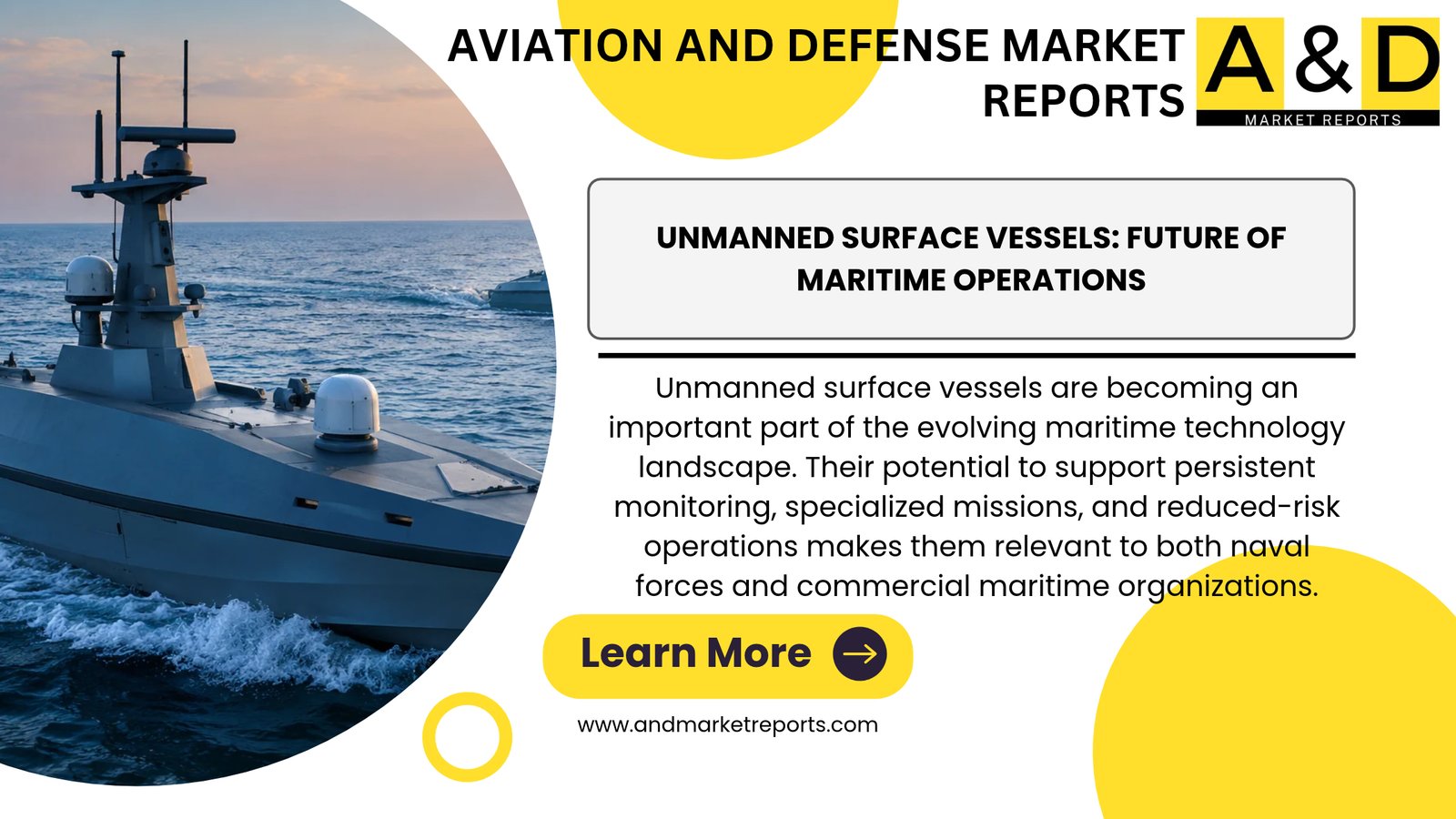
Overall, unmanned surface vessels are becoming an important part of the evolving maritime technology landscape. Their potential to support persistent monitoring, specialized missions, and reduced-risk operations makes them relevant to both naval forces and commercial maritime organizations. Companies that prioritize reliable autonomy, secure integration, regulatory compliance, and mission flexibility will be better positioned to address emerging opportunities in this developing sector.