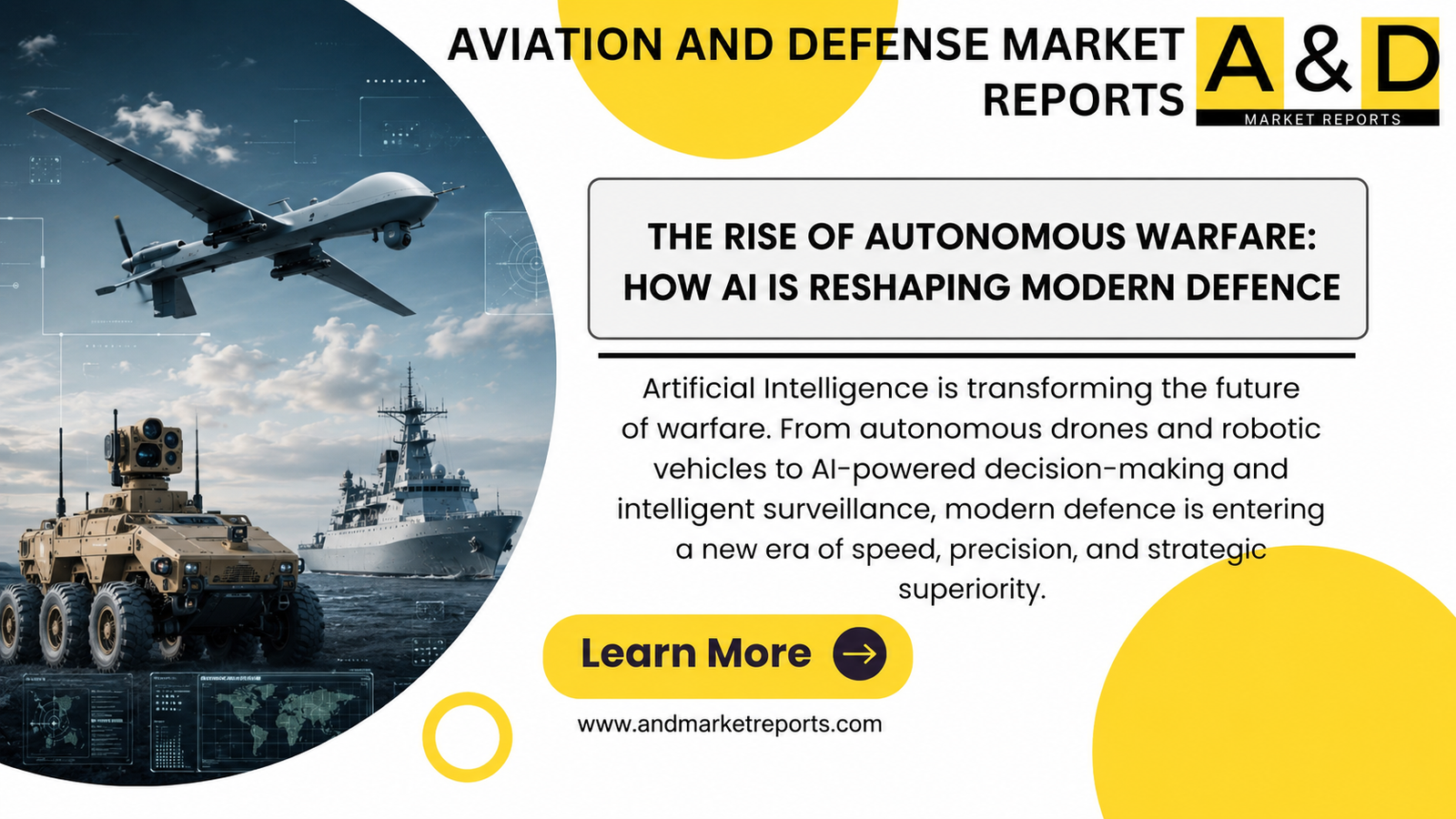

Artificial Intelligence (AI) is transforming every sector of the global economy, and the defence industry is no exception. From autonomous drones and intelligent surveillance systems to AI-powered battlefield decision support, military organizations worldwide are investing heavily in technologies that enhance operational efficiency while reducing human risk. The rise of autonomous warfare marks one of the most significant shifts in modern military strategy, where machines are increasingly capable of sensing, analyzing, and responding to threats with minimal human intervention.
While autonomous defence systems promise greater precision, faster response times, and improved situational awareness, they also introduce complex ethical, legal, and strategic challenges. Nations are now racing to integrate AI into their military capabilities, making artificial intelligence one of the defining technologies shaping the future of warfare.
Understanding Autonomous Warfare
Autonomous warfare refers to the use of military systems that can perform certain functions independently by leveraging Artificial Intelligence, machine learning, computer vision, and advanced sensor technologies. Unlike traditional weapon systems that rely entirely on human operators, autonomous systems can process vast amounts of battlefield data, identify targets, navigate complex environments, and execute missions with varying degrees of human oversight.
These technologies include:
- Autonomous aerial drones
- Unmanned Ground Vehicles (UGVs)
- Autonomous naval vessels
- AI-powered surveillance platforms
- Robotic logistics and supply systems
- Intelligent missile defence systems
Modern defence organizations continue to emphasize “human-on-the-loop” or “human-in-the-loop” approaches to ensure critical decisions remain under human supervision while AI handles repetitive, high-speed analytical tasks.
AI in Modern Defence: Transforming Military Operations
The integration of AI in modern defence has fundamentally changed how military operations are planned and executed. AI enables armed forces to process enormous volumes of intelligence from satellites, drones, radars, and communication systems in real time.
Machine learning algorithms identify patterns that would take human analysts several hours or even days to detect. This capability significantly improves battlefield awareness and enables commanders to make faster and more informed decisions.
Some major applications include:
- Real-time intelligence analysis
- Predictive maintenance of military equipment
- Automated threat detection
- Battlefield simulation and war gaming
- Mission planning optimization
- Cyber threat identification
AI-powered command systems can continuously evaluate changing battlefield conditions and recommend optimal responses, allowing military leaders to maintain operational superiority.
Autonomous Drones Are Revolutionizing Combat
Among all autonomous military technologies, unmanned aerial systems have experienced the fastest development.
Modern autonomous drones are capable of:
- Conducting reconnaissance missions
- Monitoring border security
- Performing target surveillance
- Supporting disaster response
- Executing precision strikes
- Delivering logistics in hostile environments
Unlike remotely piloted drones, AI-enabled autonomous drones can independently navigate GPS-denied environments, avoid obstacles, recognize objects, and collaborate with other unmanned systems.
Swarm drone technology represents another major breakthrough, where dozens or even hundreds of AI-controlled drones coordinate their movements to overwhelm enemy defences or conduct large-area surveillance missions.
Artificial Intelligence in Military Decision Making
One of the most transformative aspects of artificial intelligence in military decision making is its ability to support commanders during rapidly evolving combat situations.
Modern battlefields generate massive volumes of information from:
- Satellites
- ISR platforms
- Radar systems
- Electronic warfare sensors
- Cyber intelligence
- Human intelligence reports
AI systems fuse these multiple data sources into a unified operational picture, highlighting potential threats and recommending possible courses of action.
Although AI significantly accelerates decision-making, most defence organizations maintain human oversight for lethal operations to ensure accountability and compliance with international humanitarian law.
AI-Powered Cyber Defence
As military operations become increasingly digital, cybersecurity has emerged as a strategic priority.
AI plays an essential role in defending military networks by:
- Detecting abnormal network behaviour
- Identifying cyber intrusions
- Predicting potential cyberattacks
- Automating incident response
- Protecting classified information
Machine learning systems continuously monitor millions of network events, enabling faster detection of sophisticated cyber threats that traditional security systems may overlook.
Given the increasing frequency of cyber warfare, AI-driven cyber defence capabilities are becoming indispensable for national security.
Intelligent Surveillance and Battlefield Awareness
Situational awareness remains one of the most critical factors determining military success.
AI-powered surveillance integrates data from:
- Satellites
- UAVs
- Ground sensors
- Maritime surveillance systems
- Radar networks
- Electro-optical imaging
Computer vision algorithms automatically identify vehicles, aircraft, ships, personnel movements, and infrastructure changes across large geographic areas.
These systems reduce analyst workload while improving detection accuracy, enabling armed forces to respond more rapidly to emerging threats.
Future of Autonomous Warfare: Emerging Technologies
The future of autonomous warfare extends beyond today’s drones and robotic vehicles.
Several emerging technologies are expected to reshape military operations over the next decade:
Human-Machine Teaming
Rather than replacing soldiers, AI will increasingly function as an intelligent teammate, assisting personnel with navigation, target identification, logistics, and tactical planning.
Collaborative Combat Systems
Future battlefields may involve multiple autonomous platforms working together across land, sea, air, space, and cyberspace.
AI-Enabled Electronic Warfare
Artificial intelligence can rapidly analyze radio frequency environments, detect electronic threats, and recommend countermeasures far faster than traditional systems.
Autonomous Logistics
Robotic supply vehicles and unmanned cargo aircraft may automate military logistics in high-risk operational areas, reducing risks to personnel.
AI-Driven Predictive Intelligence
Advanced AI models will forecast potential conflict zones, equipment failures, and adversary actions based on historical and real-time intelligence.
Ethical and Legal Challenges
Despite its operational advantages, autonomous warfare raises significant ethical concerns.
Key questions include:
- Who remains accountable if an autonomous weapon makes an incorrect decision?
- How can civilian casualties be minimized?
- Should lethal autonomous weapons be regulated internationally?
- Can AI systems always distinguish combatants from civilians?
International organizations, policymakers, and defence experts continue to debate appropriate governance frameworks for autonomous weapon systems.
Many countries advocate maintaining meaningful human control over any AI-enabled lethal action while encouraging responsible innovation.
Challenges Limiting Full Autonomy
Although AI capabilities continue to improve, several technical limitations remain.
Autonomous military systems must overcome challenges such as:
- Adversarial AI attacks
- Sensor reliability in harsh environments
- Communication disruptions
- GPS denial
- Complex ethical decision-making
- Data bias in machine learning models
- Cybersecurity vulnerabilities
Continuous testing, validation, and human oversight remain essential to ensure these systems perform safely and reliably under operational conditions.
Conclusion
The rise of autonomous warfare represents a fundamental transformation in how modern militaries prepare for and conduct operations. Artificial intelligence is enhancing intelligence analysis, surveillance, cybersecurity, logistics, battlefield awareness, and autonomous platform capabilities at an unprecedented pace.
While AI in modern defence offers significant operational advantages—including faster decision-making, improved precision, and reduced risks to military personnel—it also introduces complex ethical, legal, and security considerations that require robust governance and international cooperation.
Looking ahead, the future of autonomous warfare will likely be characterized by closer collaboration between humans and intelligent machines rather than fully autonomous combat. As AI technologies continue to evolve, defence organizations must strike a careful balance between innovation, operational effectiveness, accountability, and adherence to international humanitarian principles. Nations that successfully integrate advanced AI while maintaining responsible oversight will be better positioned to address the evolving challenges of modern defence and global security.