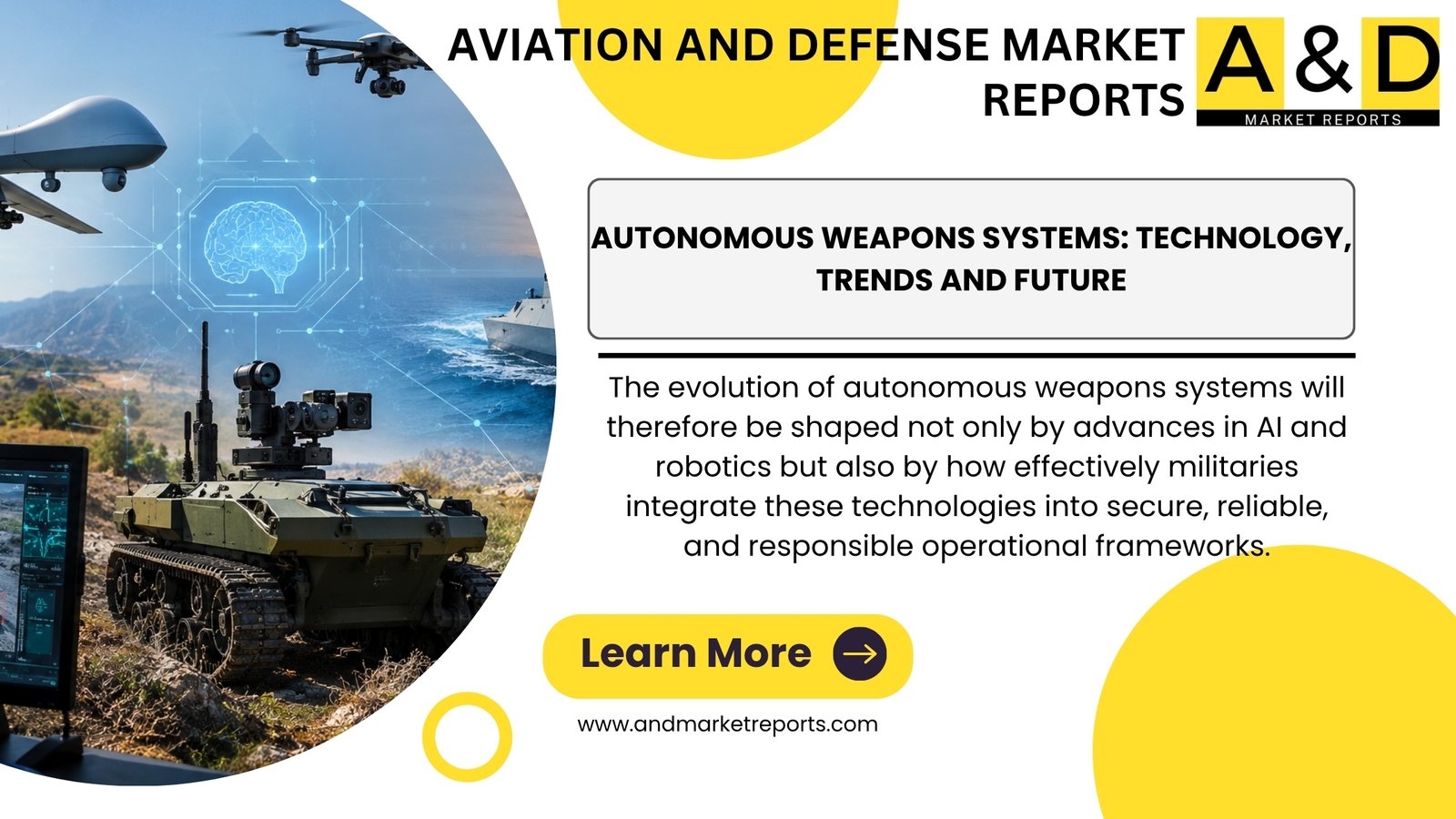

Autonomous Weapons Systems are becoming an important area of defense technology. Additionally, military forces are exploring new ways to improve situational awareness, response speed, precision, and efficiency. They use a mix of AI, machine learning, sensors, robotics, computer vision, and advanced software.
Developers are advancing autonomous capabilities across air, land, sea, and underwater domains.
Unmanned aerial vehicles (UAVs), autonomous ground vehicles, maritime systems, loitering munitions, and robotic platforms can navigate environments and identify objects.
Moreover, they can track targets and support military missions.
The rise of autonomous systems reflects a broader shift toward network-centric and data-driven warfare. Instead of relying exclusively on human operators for every stage of a mission, military organizations are exploring systems that can process information and respond rapidly while remaining integrated with human command structures.
Evolution and Role of Autonomous Weapons Systems
Military automation has existed for decades, particularly in areas such as missile guidance, navigation, surveillance, and defensive systems. However, advances in computing power, sensors, communications, and AI have significantly expanded the potential applications of autonomy.
Earlier unmanned systems generally required continuous human control. Modern platforms can perform increasingly complex tasks independently, such as maintaining flight paths, avoiding obstacles, navigating predefined routes, monitoring designated areas, and returning to a base when mission conditions change.
Autonomy can exist at different levels. Some systems automate navigation and sensing while humans remain responsible for target decisions. Others can independently manage specific mission functions within predefined parameters. This distinction is important because autonomous capability does not necessarily mean that a system operates without human supervision.
Modern military forces are therefore focusing on human-machine teaming, where autonomous platforms perform repetitive or time-sensitive tasks while personnel retain appropriate levels of oversight and decision-making authority.
Technologies Driving Autonomous Military Systems
Artificial intelligence is one of the primary technologies supporting autonomous weapons systems. AI algorithms can analyze large volumes of sensor information and identify patterns that may be difficult to process manually in real time. Machine learning can also support object recognition, navigation, classification, and predictive analysis.
Computer vision is particularly important for autonomous platforms operating in complex environments. Cameras, infrared sensors, radar, lidar, and other sensors provide information about surrounding objects and terrain. Combining data from multiple sensors can improve navigation and situational awareness.
Edge computing is another important technology. Processing information directly on an aircraft, vehicle, vessel, or drone can reduce dependence on remote data centers and minimize communication delays. This is particularly valuable in environments where communication networks may be disrupted or degraded.
Advanced navigation technologies are also supporting autonomous operations. Satellite navigation, inertial navigation, terrain mapping, simultaneous localization and mapping, and sensor-based navigation can enable platforms to operate in environments where conventional positioning signals are unavailable or unreliable.
Secure communications and resilient data links are equally important. Autonomous platforms may need to exchange information with other vehicles, command centers, satellites, and human operators while operating in contested electromagnetic environments.
Growing Applications Across Defense Domains
Autonomous systems are being developed across virtually every major defense domain. In the air domain, autonomous UAVs can perform intelligence, surveillance, and reconnaissance missions, monitor large areas, and support targeting and communications. Swarming technology is also being explored, allowing multiple unmanned platforms to coordinate their movements and distribute tasks.
In land warfare, autonomous ground vehicles can support logistics, reconnaissance, surveillance, route clearance, and other missions. Robotic vehicles can potentially perform tasks in hazardous areas while reducing the exposure of personnel to dangerous environments.
The maritime sector is another major area of development. Uncrewed surface vessels and autonomous underwater vehicles can support maritime surveillance, mine detection, oceanographic missions, and reconnaissance. Their ability to operate for extended periods can complement crewed naval platforms.
Autonomy is also becoming increasingly relevant to air-defense and counter-drone operations. Automated sensors can detect and track incoming threats, while integrated command systems can help prioritize responses and coordinate defensive assets.
Autonomous Weapons and Modern Battlefield Requirements
Modern battlefields are becoming increasingly complex due to the growing use of drones, precision weapons, electronic warfare, cyber capabilities, and large volumes of real-time data. These conditions place significant demands on military decision-making and command systems.
Autonomous technologies can help address information overload by processing sensor data and identifying relevant events more rapidly. They can also support operations in environments where human access is difficult or dangerous.
Speed is another factor driving interest in autonomous systems. In some scenarios, the time between detecting a threat and responding to it can be extremely short. Automated processes can reduce delays in navigation, detection, tracking, and defensive operations.
However, military autonomy is not simply about replacing human operators. The emphasis is increasingly on combining machine speed and computational capabilities with human judgment, operational experience, and accountability.
Challenges and Ethical Considerations
Despite their potential, autonomous weapons systems face significant technical, operational, legal, and ethical challenges. One major challenge is ensuring that autonomous systems can reliably distinguish objects and situations under changing battlefield conditions.
Sensors can be affected by weather, camouflage, clutter, electronic interference, and unexpected objects. AI models can also produce incorrect classifications. A system that performs well during testing may encounter substantially different conditions during actual operations.
Cybersecurity is another critical concern. Autonomous systems rely heavily on software, communications, sensors, and digital infrastructure. Protecting these systems against cyberattacks, spoofing, jamming, and data manipulation is essential.
Human oversight remains a major area of discussion. Governments, militaries, researchers, and international organizations continue to debate how autonomous capabilities should be designed, tested, deployed, and controlled, particularly when systems are involved in the use of force.
Accountability is also important. Clear chains of command, rules of engagement, testing procedures, and operational safeguards are necessary to ensure that autonomous capabilities remain subject to appropriate human responsibility.
Future Outlook
The future development of autonomous weapons systems is likely to focus on greater reliability, improved sensor fusion, advanced AI, resilient communications, and human-machine teaming. Rather than operating as isolated platforms, autonomous systems are increasingly expected to function as part of connected defense networks.
Swarming technology could become an important area of development for Autonomous Weapons Systems.
Additionally, AI-enabled mission planning could further improve the ability of autonomous platforms to respond to dynamic environments.
Another emerging direction is the development of collaborative combat systems in which crewed aircraft, unmanned aircraft, ground vehicles, and naval platforms operate together. Such systems could distribute surveillance, electronic warfare, communications, and other mission functions across multiple platforms.
Advances in edge computing and AI hardware could also allow autonomous systems to process more information onboard without depending continuously on external networks. This could improve responsiveness and resilience in contested environments.
Meanwhile, future development will depend on rigorous testing, cybersecurity, and human oversight. Additionally, it will rely on international discussions and clear operational policies for Autonomous Weapons Systems.
Conclusion
The rise of autonomous weapons systems represents a significant development in modern military technology. AI, robotics, advanced sensors, autonomous navigation, edge computing, and secure communications are enabling defense platforms to perform increasingly sophisticated tasks with reduced levels of direct human control.
From UAVs and robotic ground vehicles to autonomous maritime platforms and counter-drone systems, autonomy is expanding across multiple operational domains. These technologies can improve response speed, support personnel in hazardous environments, and process large volumes of battlefield information.
However, autonomous military systems also introduce complex challenges involving reliability, cybersecurity, human oversight, accountability, and operational control. As defense organizations continue investing in autonomy, the focus is likely to remain on developing systems that combine machine capabilities with appropriate human supervision.
The evolution of autonomous weapons systems will therefore be shaped not only by advances in AI and robotics but also by how effectively militaries integrate these technologies into secure, reliable, and responsible operational frameworks.