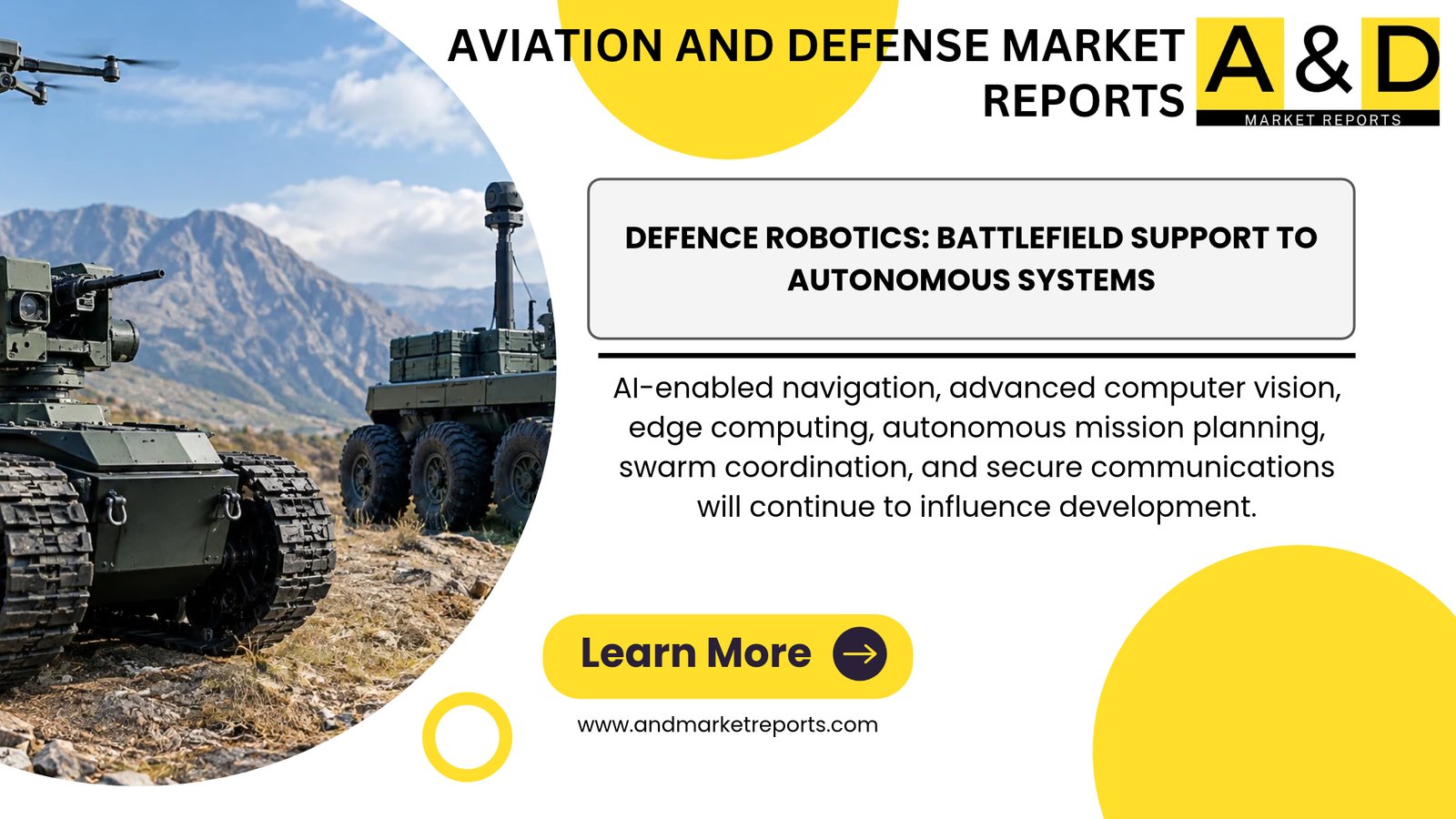

Defence robotics is becoming an important part of modern military operations, transforming how armed forces perform surveillance, logistics, reconnaissance, explosive ordnance disposal, border security, and other battlefield missions. Defence robots combine robotics, artificial intelligence, sensors, communications, navigation, and autonomous control to perform tasks that may be dangerous, repetitive, or difficult for human personnel.
Military robotics ranges from small ground robots and unmanned aerial systems to autonomous naval platforms and sophisticated robotic vehicles. While early systems were primarily designed to support soldiers, technological progress is moving the industry toward increasingly autonomous operations.
The growing focus on reducing risks to military personnel, improving situational awareness, increasing operational endurance, and supporting multi-domain operations is expected to drive continued investment in defence robotics.
Evolution of Defence Robotics
The evolution of defence robotics has progressed from remotely controlled machines toward semi-autonomous and increasingly autonomous platforms. Early military robots were mainly developed for bomb disposal, surveillance, and hazardous-area inspection. Operators controlled these systems remotely and made most mission decisions.
Advances in computing, sensors, artificial intelligence, communications, and navigation have significantly expanded their capabilities. Modern robotic platforms can process information from cameras, radar, thermal sensors, LiDAR, and other systems to understand their surroundings and support navigation.
Unmanned ground vehicles (UGVs), unmanned aerial vehicles (UAVs), unmanned surface vessels (USVs), and autonomous underwater vehicles (AUVs) can now perform missions across land, air, and maritime environments. This evolution is gradually moving defence robotics from simple battlefield support toward collaborative and autonomous operations.
Battlefield Support and Logistics
One of the most established applications of defence robotics is battlefield support. Robotic systems can transport ammunition, equipment, food, medical supplies, and other materials across difficult terrain. Autonomous logistics vehicles can potentially reduce the exposure of personnel operating in high-risk environments.
Robotic platforms can also support casualty evacuation by transporting injured personnel away from dangerous areas. In addition, robotic systems can be used for route clearance, engineering support, reconnaissance, and infrastructure inspection.
The use of robotic logistics systems can improve operational efficiency while allowing soldiers to focus on tasks that require human judgment and decision-making.
Intelligence, Surveillance and Reconnaissance
Defence robotics is playing an increasingly important role in intelligence, surveillance, and reconnaissance (ISR). Unmanned platforms equipped with electro-optical cameras, infrared sensors, radar, and other payloads can monitor large areas and provide real-time information to military personnel.
Small robotic systems can operate in urban environments, tunnels, buildings, and other locations where conventional surveillance platforms may have limitations. Ground robots can inspect suspicious areas, while drones can provide aerial imagery and situational awareness.
Artificial intelligence can help process large volumes of sensor data, identify objects, detect changes, and prioritize information for human operators. This can reduce the workload associated with monitoring and analyzing battlefield information.
Autonomous Operations and Human-Robot Collaboration
The transition toward autonomous operations represents one of the most significant developments in defence robotics. Autonomous systems can use onboard sensors, navigation technologies, and software to perform predefined missions with reduced operator intervention.
However, military robotics is increasingly focused on human-machine collaboration rather than simply removing humans from the decision-making process. Human operators can establish mission objectives, monitor robotic systems, and intervene when necessary, while autonomous platforms perform navigation, data collection, or other supporting functions.
Collaborative robotic teams could allow multiple platforms to operate together. For example, aerial, ground, and maritime robots could share information and coordinate movements through networked command systems.
Key Technologies Driving Defence Robotics
Several technologies are accelerating the development of defence robotics. Artificial intelligence and machine learning enable robotic systems to process sensor information, recognize patterns, support navigation, and make decisions within defined operational parameters.
Computer vision allows robots to interpret images and identify objects or obstacles. LiDAR, radar, thermal imaging, and multispectral sensors improve perception in challenging environments.
Advanced navigation technologies are also essential. GPS and inertial navigation systems can be combined with visual navigation and other positioning technologies to improve performance when satellite signals are unavailable or degraded.
Another important development is secure military communications. Reliable connectivity enables robotic platforms to exchange information with command centers and other unmanned systems. Edge computing can allow robots to process information locally, reducing dependence on remote data centers.
Multi-Domain Robotic Operations
Future defence robotics will increasingly involve multiple types of autonomous systems operating together. This concept is particularly important in multi-domain operations, where land, air, maritime, space, and cyber capabilities need to work as an integrated network.
For example, an unmanned aerial platform could provide reconnaissance information to ground robots, while maritime unmanned systems monitor coastal areas. A centralized command architecture could combine information from these platforms to create a broader operational picture.
This interconnected approach can improve situational awareness and enable military forces to distribute missions among multiple robotic platforms rather than relying exclusively on individual systems.
Growing Defence Robotics Production and Procurement
Military organizations are increasing investments in unmanned and robotic technologies as part of broader modernization programs. Defence manufacturers and technology companies are developing robotic platforms for reconnaissance, logistics, surveillance, engineering, explosive ordnance disposal, and other applications.
Modular robotic designs are becoming particularly important because they allow different sensors and mission payloads to be integrated according to operational requirements. This flexibility can reduce development costs and enable a single platform to support multiple missions.
Countries are also encouraging domestic development of robotics, artificial intelligence, sensors, and autonomous technologies to strengthen defence supply chains and technological independence.
Regional Market Developments
North America remains a major centre for defence robotics development because of strong investments in autonomous systems, AI, unmanned vehicles, and military modernization. The United States is pursuing robotic technologies across ground, air, and maritime domains.
Europe is increasing investments in autonomous platforms, robotics, AI, and collaborative defence technologies. European countries are also emphasizing interoperability and joint development programs.
Asia-Pacific is expected to experience significant growth as countries modernize their armed forces and invest in unmanned systems. India, China, Japan, South Korea, and Australia are developing capabilities across ground, aerial, and maritime robotics.
In the Middle East, robotics and autonomous systems are attracting attention for border surveillance, critical infrastructure protection, reconnaissance, and military applications. Emerging defence industries in the region are also investing in domestic unmanned technology development.
Challenges Affecting Defence Robotics
Despite its potential, defence robotics faces several challenges. Operating autonomous systems in unpredictable battlefield environments requires reliable sensors, robust navigation, secure communications, and advanced software.
Cybersecurity is another critical concern. Connected robotic platforms may become targets for electronic warfare, communication disruption, or cyber attacks. Developers therefore need to incorporate secure architectures and resilient communications.
Battery life, power density, mobility, weather resistance, maintenance, and payload capacity can also limit robotic performance. Furthermore, autonomous decision-making raises important questions about human oversight, accountability, reliability, and the appropriate level of autonomy in military operations.
Interoperability can be another challenge because robotic systems from different manufacturers and military branches may use different communications protocols and software architectures.
Future Outlook of Defence Robotics
The future of defence robotics is expected to move toward greater autonomy, intelligence, interoperability, and human-machine collaboration. Instead of operating as isolated platforms, robots are likely to become components of connected military ecosystems.
AI-enabled navigation, advanced computer vision, edge computing, autonomous mission planning, swarm coordination, and secure communications will continue to influence development. Robotic systems are also expected to become smaller, more modular, energy-efficient, and capable of carrying specialized payloads.
The long-term direction of defence robotics will therefore extend beyond replacing human soldiers in dangerous tasks. Its greater value will come from creating a force multiplier that improves endurance, situational awareness, logistics, operational reach, and decision support.
As militaries continue to adopt multi-domain strategies, defence robotics will increasingly transition from battlefield support to coordinated autonomous operations, making robotics and AI important pillars of future defence modernization.