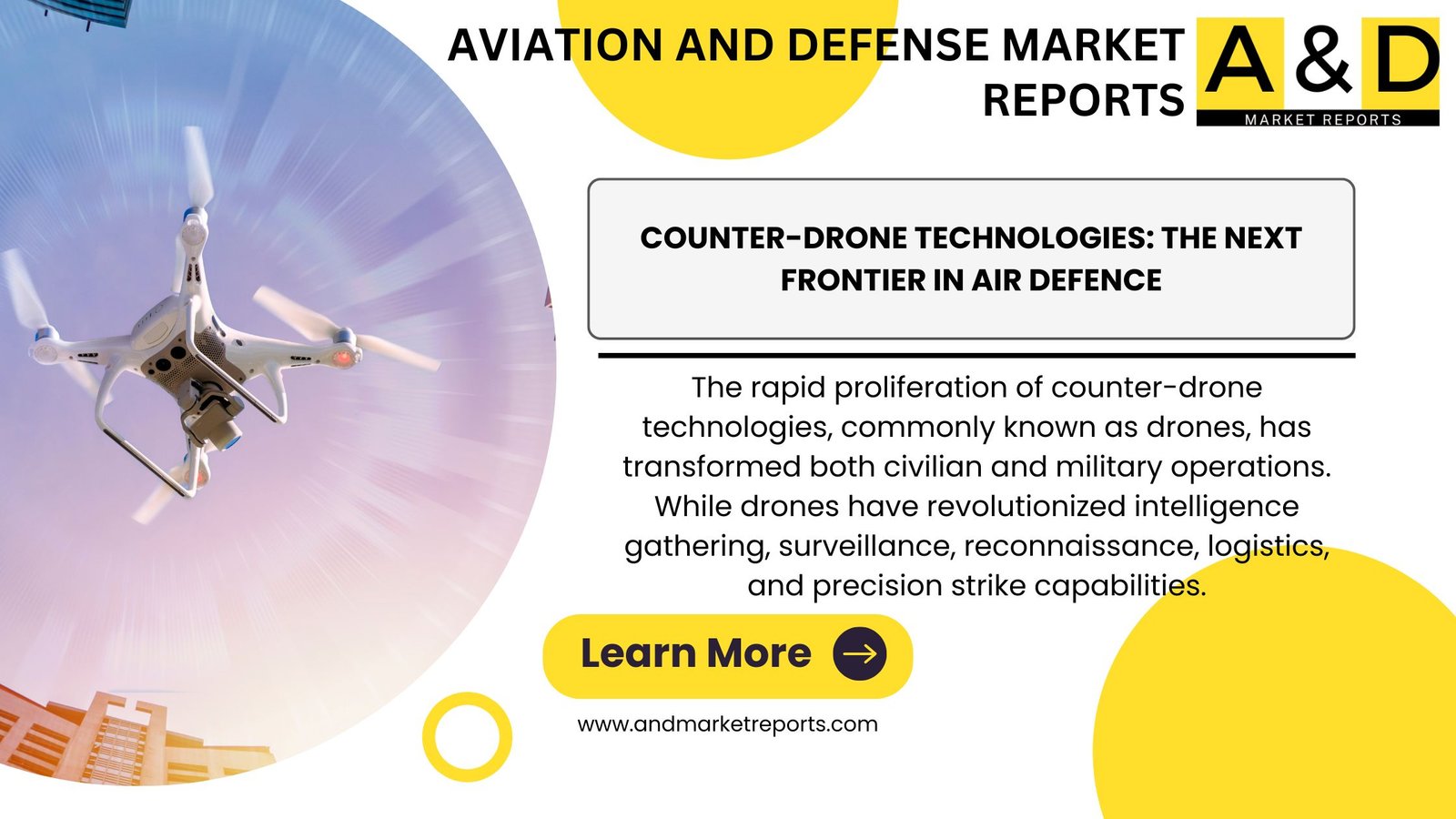

The rapid proliferation of counter-drone technologies, commonly known as drones, has transformed both civilian and military operations. While drones have revolutionized intelligence gathering, surveillance, reconnaissance, logistics, and precision strike capabilities, they have also introduced new security challenges. From small commercial quadcopters modified to carry explosives to sophisticated military unmanned combat aerial vehicles (UCAVs), drones have become an increasingly common feature of modern battlefields. Their affordability, ease of deployment, and ability to evade conventional air defence systems have made them a preferred weapon for both state militaries and non-state actors.
As a result, counter-drone technologies have emerged as one of the fastest-growing segments of the global defence industry. Modern armed forces are investing heavily in advanced Counter-Unmanned Aircraft Systems (C-UAS) that can detect, track, identify, and neutralize hostile drones before they threaten critical infrastructure, military personnel, or strategic assets. These technologies are reshaping air defence strategies and becoming an essential layer within integrated air and missile defence networks.
The Rising Threat of Unmanned Aerial Systems
The widespread availability of low-cost drones has fundamentally changed the nature of aerial threats. Unlike traditional fighter aircraft or cruise missiles, drones are inexpensive, difficult to detect, and capable of operating at low altitudes with minimal radar signatures. Swarm attacks involving dozens or even hundreds of drones further complicate defence operations by overwhelming conventional air defence systems.
Recent military conflicts have demonstrated how drones can conduct intelligence gathering, artillery spotting, electronic warfare, precision strikes, and coordinated swarm attacks. Critical infrastructure such as military bases, airports, power plants, oil refineries, naval vessels, and government facilities have increasingly become targets for unmanned aerial systems.
The growing diversity of drone platforms—including fixed-wing UAVs, rotary-wing drones, loitering munitions, and autonomous swarm systems—requires equally advanced defensive technologies capable of responding to multiple threat types simultaneously.
Understanding Counter-Drone Technologies
Counter-drone technologies are designed to detect, classify, monitor, and neutralize unauthorized or hostile unmanned aerial systems. Rather than relying on a single solution, modern C-UAS systems integrate multiple sensors and effectors to provide comprehensive protection.
The operational process generally begins with early detection through radar systems, radio frequency (RF) sensors, electro-optical cameras, infrared sensors, acoustic detectors, and artificial intelligence-powered surveillance software. Once a drone is identified, tracking systems continuously monitor its trajectory while advanced algorithms determine whether it poses a legitimate threat.
Neutralization options vary depending on operational requirements. Some systems use electronic warfare techniques to jam communication links or disrupt satellite navigation signals, forcing drones to land or return to their launch points. Others employ kinetic interceptors, guided missiles, rapid-fire guns, interceptor drones, directed-energy weapons, or high-power microwave systems to physically destroy hostile aircraft.
This layered defence approach significantly improves response times while reducing the risk of collateral damage.
Technological Innovations Driving Counter-Drone Systems
Rapid technological advancement is accelerating the evolution of counter-drone capabilities. Artificial intelligence and machine learning now play a central role in threat identification by distinguishing hostile drones from birds, civilian aircraft, or friendly UAVs. These intelligent systems dramatically reduce false alarms while improving detection accuracy.
Advanced radar technologies have also become more effective at identifying extremely small aerial targets with low radar cross-sections. Multi-static radar networks, passive radar systems, and three-dimensional surveillance radars provide greater situational awareness across complex operational environments.
Directed-energy weapons represent another major breakthrough. High-energy lasers can disable or destroy drones almost instantly while offering extremely low cost per engagement. Similarly, high-power microwave weapons disrupt onboard electronics, making them particularly effective against drone swarms without relying on conventional ammunition.
Electronic warfare continues to evolve through more sophisticated RF jamming, GPS spoofing, cyber takeover capabilities, and spectrum monitoring systems. These non-kinetic approaches provide flexible engagement options while minimizing collateral damage in urban or civilian environments.
Furthermore, autonomous interceptor drones equipped with onboard artificial intelligence are beginning to play an increasingly important role in pursuing and neutralizing hostile unmanned aircraft.
Military Applications Across Multiple Domains
Counter-drone technologies have become essential across all military branches. Air forces deploy C-UAS systems to protect airbases, radar installations, command centres, and aircraft from surveillance and attack drones. Early detection enables rapid response before hostile UAVs can compromise operational security.
Naval forces integrate counter-drone systems onboard warships, aircraft carriers, amphibious assault ships, and coastal defence installations. Maritime operations require specialized solutions capable of detecting drones against complex sea clutter while protecting valuable naval assets from aerial and surface threats.
Land forces increasingly rely on mobile counter-drone platforms to safeguard armored formations, artillery batteries, logistics convoys, and forward operating bases. Vehicle-mounted systems provide continuous protection during rapidly changing battlefield conditions.
Critical military infrastructure, including ammunition depots, communication hubs, missile batteries, and strategic command facilities, also depends on integrated counter-drone networks to maintain uninterrupted operational capability.
Growing Global Investments Supporting Market Expansion
The global demand for counter-drone technologies continues to accelerate as governments recognize the increasing threat posed by unmanned aerial systems. Defence modernization programs across North America, Europe, Asia-Pacific, and the Middle East are prioritizing investments in layered air defence architectures that include dedicated counter-drone capabilities.
Military procurement agencies are funding research into artificial intelligence, advanced sensors, directed-energy weapons, electronic warfare, and autonomous interception technologies. At the same time, defence manufacturers are expanding production capacity to meet rising domestic and international demand.
Several countries are also encouraging indigenous development of counter-drone systems to reduce dependence on imported technologies while strengthening national defence industries. Collaborative partnerships between governments, defence contractors, and technology companies are further accelerating innovation across the sector.
The growing use of drones by civilian agencies has also increased demand for dual-use counter-drone solutions capable of protecting airports, government buildings, public events, energy facilities, and transportation infrastructure.
Challenges Facing Counter-Drone Development
Despite rapid progress, several challenges continue to affect the deployment of counter-drone technologies. Detecting small drones with minimal radar signatures remains technically demanding, particularly in densely populated urban environments where background interference is significant.
Drone swarms present another major challenge. Simultaneously tracking and engaging dozens of autonomous aircraft requires highly advanced sensors, artificial intelligence, and rapid-response interception systems.
Electronic warfare solutions may be less effective against autonomous drones operating without continuous communication links or GPS dependence. Likewise, kinetic interception methods can create debris hazards, particularly when operating near civilian infrastructure.
Another challenge involves balancing security with regulatory compliance. Counter-drone systems operating near airports, populated areas, or commercial airspace must ensure that legitimate civilian drones and aircraft are not unintentionally affected.
Finally, the rapid pace of drone innovation requires continuous investment in research and development, forcing defence organizations to constantly update both hardware and software to counter emerging threats.
Regional Developments in the Counter-Drone Market
North America remains one of the leading markets for counter-drone technologies, supported by significant defence spending, advanced research programs, and strong collaboration between government agencies and defence manufacturers.
Europe is strengthening integrated air defence capabilities through investments in electronic warfare, laser weapons, and advanced surveillance technologies. Regional defence cooperation is also encouraging the development of standardized C-UAS solutions.
Asia-Pacific is experiencing the fastest growth due to increasing military modernization, border security concerns, and expanding domestic drone industries. Several countries are rapidly deploying indigenous counter-drone technologies across land, naval, and air platforms.
The Middle East continues to invest heavily in counter-drone capabilities to protect critical energy infrastructure, military facilities, and urban centres from evolving aerial threats. Other emerging regions are gradually expanding procurement as drone usage becomes more widespread.
Future Outlook
Counter-drone technologies are expected to become a defining element of future air defence strategies. As drones become faster, smarter, and increasingly autonomous, military organizations will require equally intelligent defensive systems capable of operating across highly contested environments.
Future developments are likely to include artificial intelligence-enabled autonomous defence networks, quantum-enhanced sensors, next-generation directed-energy weapons, advanced microwave systems, and fully integrated multi-domain command-and-control architectures. These innovations will improve detection accuracy, reduce engagement times, and enable coordinated responses against complex drone swarms.
The convergence of sensor fusion, machine learning, cybersecurity, and autonomous interception will further strengthen the effectiveness of counter-drone systems. As military forces continue to modernize and aerial threats evolve, counter-drone technologies will remain at the forefront of air defence innovation, ensuring greater protection for personnel, infrastructure, and national security interests in the years ahead.