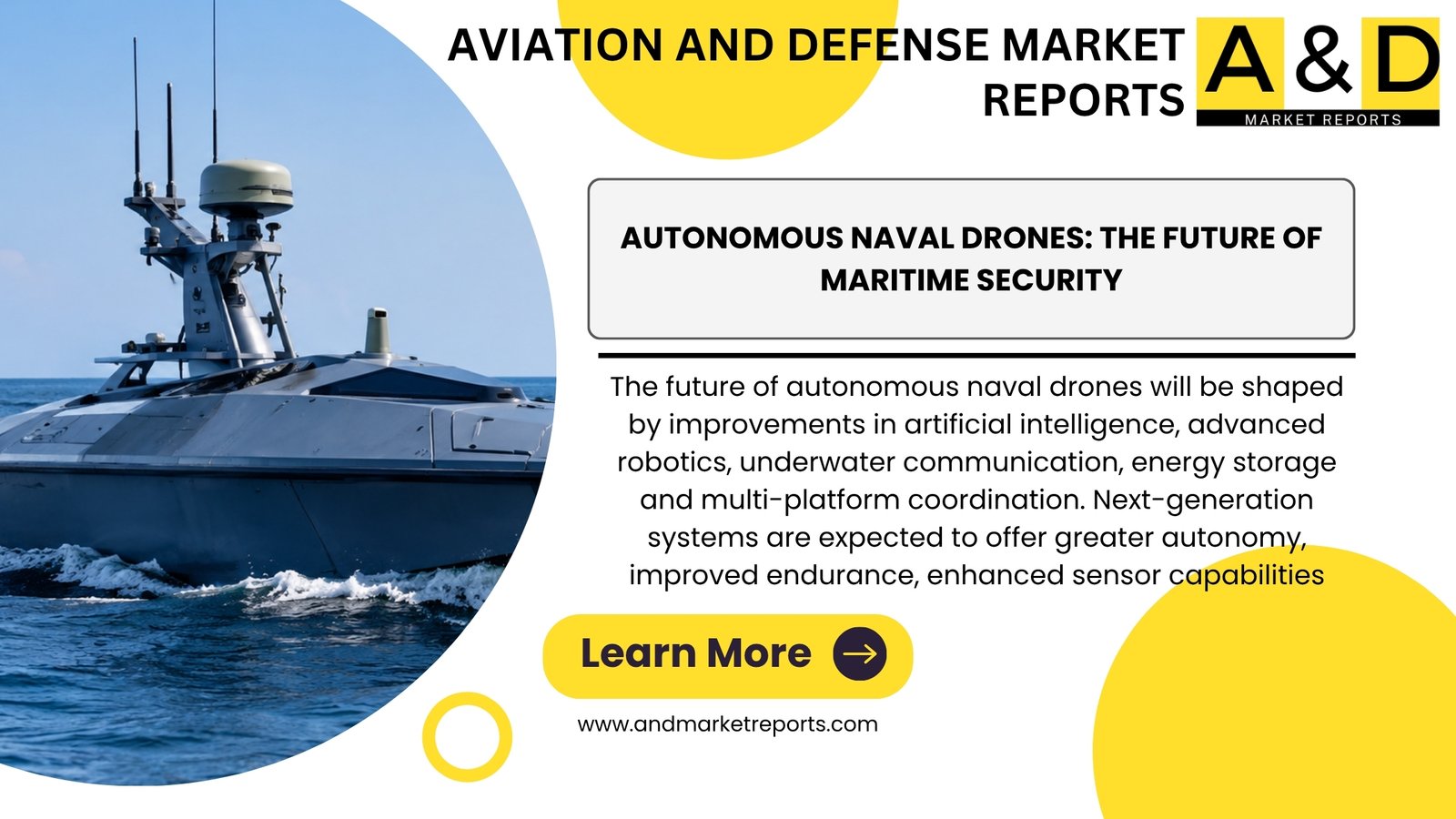

Autonomous naval drones are emerging as transformative technologies in modern maritime security, offering naval forces new capabilities for surveillance, reconnaissance, underwater monitoring and maritime operations. These unmanned platforms are designed to operate with varying levels of human supervision, using artificial intelligence (AI), advanced sensors, navigation technologies and autonomous control systems to perform missions across complex maritime environments. As geopolitical tensions, maritime territorial disputes and threats to critical offshore infrastructure increase, countries are investing in autonomous naval systems to strengthen their maritime defence capabilities.
Autonomous naval drones include unmanned surface vehicles (USVs), unmanned underwater vehicles (UUVs) and autonomous underwater vehicles (AUVs). These platforms can conduct extended missions without requiring personnel onboard, reducing operational risks while improving the coverage and efficiency of naval operations. Their growing adoption is reshaping how countries monitor territorial waters, protect shipping routes and respond to emerging maritime threats.
Evolution of Autonomous Naval Drone Technology
The development of autonomous naval drones has progressed significantly from remotely controlled experimental platforms to sophisticated unmanned systems capable of performing complex missions. Initially, unmanned maritime vehicles were primarily used for mine detection, oceanographic research and underwater inspections. However, improvements in satellite communications, artificial intelligence, battery technology and autonomous navigation have expanded their applications across defence and commercial maritime sectors.
Modern autonomous naval drones can navigate predefined routes, identify objects, collect intelligence and transmit operational data to naval command centres. Several countries are also developing collaborative unmanned systems capable of operating alongside conventional warships, submarines and maritime patrol aircraft. This shift towards networked naval operations is increasing the importance of autonomous platforms in future maritime strategies.
Importance of Autonomous Naval Drones in Maritime Security
Maritime security requires continuous monitoring of extensive ocean territories, coastal areas, international shipping routes and strategically important maritime infrastructure. Conventional naval vessels and manned surveillance aircraft can be expensive to operate over extended periods. Autonomous naval drones provide an alternative by supporting persistent monitoring with reduced personnel requirements.
One of their major advantages is their ability to conduct intelligence, surveillance and reconnaissance (ISR) missions across large maritime areas. Equipped with radar, electro-optical sensors, infrared cameras and acoustic monitoring systems, these platforms can detect suspicious vessels, monitor maritime activities and identify potential security threats.
Autonomous underwater systems also contribute to protecting submarine communication cables, offshore energy installations and underwater infrastructure. They can inspect seabed conditions, identify unusual underwater activity and support mine countermeasure operations. In addition, unmanned surface platforms can assist naval forces in monitoring restricted maritime zones and improving situational awareness.
Their ability to operate in dangerous or difficult-to-access environments also reduces the exposure of naval personnel to hostile conditions, particularly during mine detection, underwater inspections and high-risk surveillance missions.
Key Technologies Driving Autonomous Naval Drones
The operational effectiveness of autonomous naval drones depends on the integration of several advanced technologies. Artificial intelligence and machine learning enable these platforms to process sensor information, recognise maritime objects and support autonomous navigation. AI-powered systems can also analyse changing environmental conditions and assist operators in identifying potential threats.
Advanced navigation technologies, including satellite positioning, inertial navigation systems and acoustic positioning, allow unmanned platforms to maintain accurate positioning across different maritime environments. For underwater drones, these capabilities are particularly important because conventional satellite navigation signals cannot directly reach submerged vehicles.
Sensor integration is another important development. Modern platforms combine radar, sonar, cameras, environmental sensors and communication systems to improve detection and monitoring capabilities. Secure communication networks enable the exchange of operational information between unmanned vehicles and naval command centres.
Battery improvements, hybrid propulsion and energy-efficient power management systems are also extending operational endurance. These developments allow autonomous platforms to conduct longer missions while reducing the need for frequent recovery and maintenance.
Growing Military Applications and Market Expansion
The increasing use of autonomous naval drones is creating new opportunities across naval defence and maritime security programmes. Military forces are deploying unmanned surface and underwater systems for maritime surveillance, anti-submarine warfare support, mine countermeasures, intelligence collection and protection of naval installations.
Unmanned surface vehicles are particularly valuable for coastal patrol, reconnaissance and maritime domain awareness. Larger platforms can accommodate advanced radar systems, communication equipment and specialised mission payloads. Meanwhile, underwater drones are increasingly being used for seabed mapping, mine detection, submarine infrastructure inspection and underwater surveillance.
Another emerging application involves coordinated operations between multiple unmanned platforms. Through collaborative mission planning and networked communication, naval forces can deploy groups of autonomous systems to cover wider maritime areas. This approach can improve surveillance coverage and provide additional operational flexibility.
The commercial maritime sector is also contributing to market expansion. Autonomous drones are increasingly being considered for offshore oil and gas inspections, port security, environmental monitoring, oceanographic research and underwater infrastructure maintenance. As technology matures, the overlap between commercial and defence applications is expected to accelerate innovation and investment.
Regional Developments and Competitive Landscape
The United States, China, Russia, the United Kingdom, France, Japan, South Korea and several European countries are investing in autonomous maritime technologies to strengthen their naval capabilities. The United States is advancing unmanned surface and underwater platforms through naval modernisation initiatives, while China is expanding its capabilities in autonomous maritime systems as part of its broader naval development strategy.
European defence manufacturers are also developing advanced unmanned maritime platforms for surveillance, mine countermeasures and underwater operations. Companies such as Saab, Thales, Kongsberg, Leonardo and L3Harris Technologies are contributing to the development of autonomous navigation, sensor integration and unmanned maritime solutions.
In India, the growing emphasis on maritime domain awareness and indigenous defence manufacturing is creating opportunities for autonomous naval technologies. Research institutions, defence organisations and private-sector manufacturers are exploring unmanned platforms for coastal surveillance, underwater monitoring and naval operations. These developments are particularly relevant to India’s maritime security requirements across the Indian Ocean Region.
Challenges Affecting Market Growth
Despite their growing importance, autonomous naval drones face several technological and operational challenges. Communication limitations remain a major concern, particularly for underwater platforms operating at considerable depths. Radio-frequency signals cannot effectively penetrate seawater, requiring specialised acoustic communication technologies that generally offer lower data transmission rates.
Cybersecurity is another critical issue. As autonomous systems increasingly depend on digital networks, satellite communications and AI-based decision-making, they may become vulnerable to cyberattacks, signal interference and electronic warfare. Ensuring secure communications and reliable control systems is essential for military deployment.
Other challenges include limited battery endurance, harsh ocean conditions, navigation accuracy, system reliability and high development costs. The integration of autonomous platforms into existing naval command structures also requires common communication standards, operational testing and clear human-supervision procedures.
Regulatory considerations surrounding autonomous maritime operations, international maritime law and accountability for system failures will also influence wider adoption.
Future Outlook of Autonomous Naval Drones
The future of autonomous naval drones will be shaped by improvements in artificial intelligence, advanced robotics, underwater communication, energy storage and multi-platform coordination. Next-generation systems are expected to offer greater autonomy, improved endurance, enhanced sensor capabilities and more effective integration with conventional naval assets.
Collaborative unmanned operations are likely to become increasingly important, allowing multiple surface and underwater platforms to share information and perform coordinated maritime surveillance missions. Developments in AI-enabled data processing will further improve threat identification and operational decision-making.
As countries prioritise maritime security, naval modernisation and the protection of critical underwater infrastructure, demand for autonomous naval drones is expected to increase. Continued investment in research, indigenous manufacturing and international defence partnerships will support technological advancement.
Ultimately, autonomous naval drones are positioned to become an important component of future maritime security architectures, providing naval forces with more persistent surveillance, operational flexibility and improved access to challenging maritime environments.