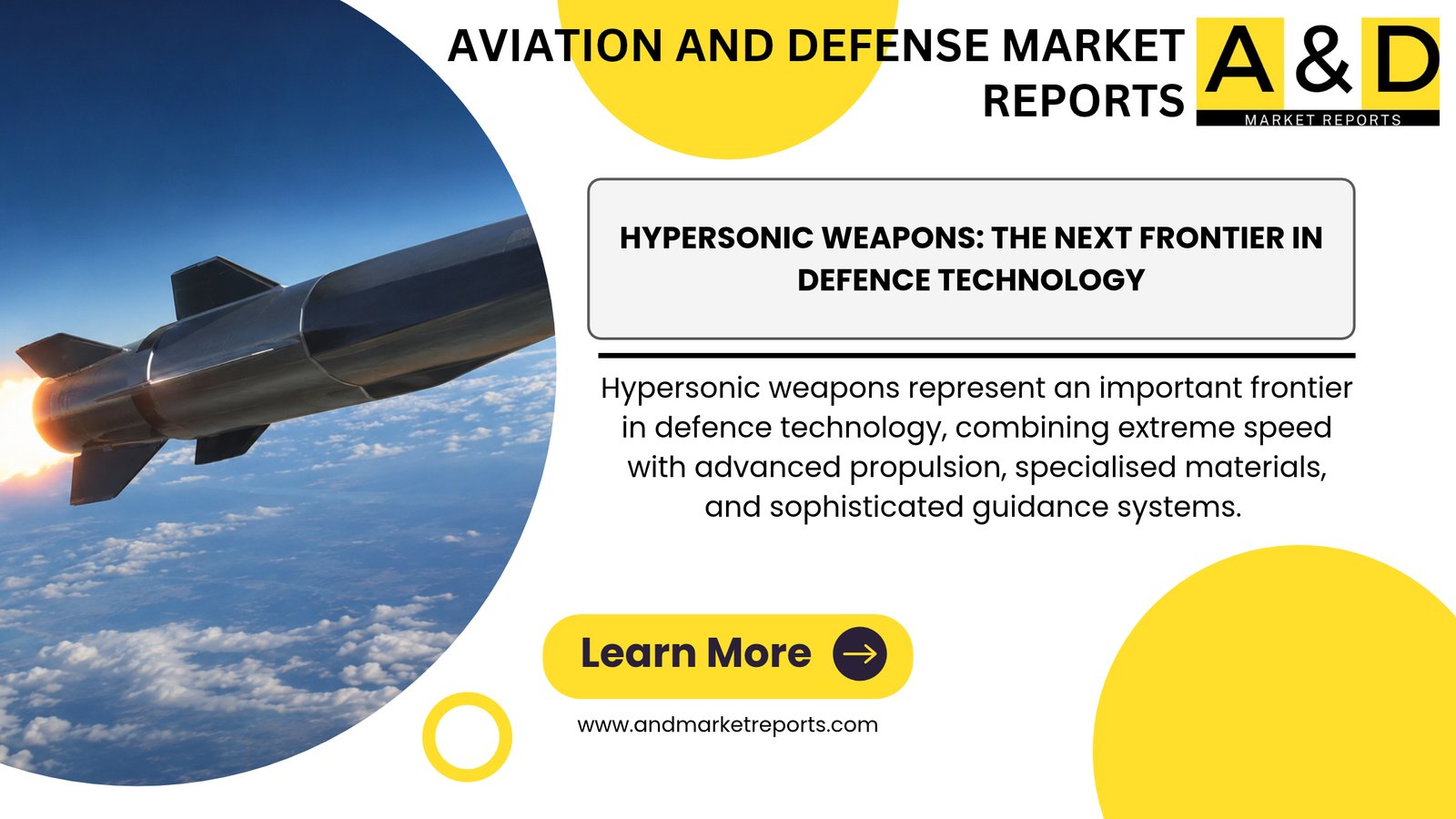

Hypersonic weapons are emerging as one of the most significant developments in modern defence technology. Designed to travel at speeds exceeding Mach 5, or five times the speed of sound, these advanced weapons are attracting growing attention from military organisations, defence manufacturers, and governments worldwide. Their combination of extreme speed, manoeuvrability, and advanced flight capabilities presents new challenges for traditional air and missile defence systems.
As global military competition intensifies, countries are investing in hypersonic research and development to strengthen strategic deterrence, improve strike capabilities, and maintain technological advantages. Developments in propulsion systems, high-temperature materials, guidance technologies, and advanced sensors are helping accelerate progress in this field.
However, hypersonic weapons also introduce considerable engineering challenges, including extreme aerodynamic heating, material degradation, guidance accuracy, and high development costs. Understanding these technologies is essential for evaluating their potential impact on future defence strategies and the global aerospace and defence industry.
What Are Hypersonic Weapons?
Hypersonic weapons are generally defined as weapons that travel at speeds greater than Mach 5. Although some conventional ballistic missiles can also reach hypersonic speeds during flight, modern hypersonic weapon programmes often focus on combining high velocity with sustained atmospheric flight or manoeuvrability.
Two major categories dominate current development: hypersonic glide vehicles and hypersonic cruise missiles.
Hypersonic Glide Vehicles (HGVs) are typically launched using a rocket booster before separating and gliding through the atmosphere at very high speeds. Their ability to manoeuvre during flight can make their trajectories more difficult to predict than those of conventional ballistic warheads.
Hypersonic Cruise Missiles (HCMs) are designed to sustain high-speed atmospheric flight using advanced propulsion technologies, potentially including scramjet engines. Unlike rocket-powered systems that accelerate and then coast, air-breathing hypersonic cruise missiles use oxygen from the atmosphere to support combustion during powered flight.
Both categories require sophisticated engineering to manage heat, maintain structural integrity, and achieve reliable guidance at extreme speeds. Their operational effectiveness depends not only on speed but also on range, accuracy, survivability, mission requirements, and the ability to integrate with existing military systems.
Key Technologies Driving Hypersonic Weapons Development
Hypersonic weapons rely on advances across several areas of aerospace engineering, materials science, propulsion, and digital technology.
Advanced Propulsion Systems: Propulsion is one of the most important elements of hypersonic development. Scramjet engines, or supersonic combustion ramjets, are being researched for air-breathing missiles that operate at very high speeds. These engines can potentially provide sustained propulsion during atmospheric flight, but they require carefully controlled airflow, specialised combustion systems, and demanding thermal management. Rocket boosters may also be needed to accelerate a vehicle to the operating conditions required by its propulsion system.
High-Temperature Materials: Extreme aerodynamic heating can expose hypersonic vehicles to temperatures capable of damaging conventional aerospace materials. Manufacturers are therefore developing advanced ceramics, thermal protection systems, heat-resistant alloys, and specialised composite structures. These materials must withstand intense thermal loads while maintaining strength, stability, and relatively low weight.
Guidance and Navigation Systems: Accurate navigation is particularly challenging when a vehicle travels at extreme speeds through a complex atmospheric environment. Advanced inertial navigation, satellite navigation where available, onboard computing, and specialised guidance technologies can contribute to reliable flight control. Engineers must also account for aerodynamic forces, communication limitations, and potential sensor interference.
Aerodynamic Design: Hypersonic vehicles experience complex airflow, shock waves, and substantial thermal loads. Their shapes must balance aerodynamic efficiency, manoeuvrability, structural strength, and thermal protection. Computational modelling, wind-tunnel testing, and flight experiments are essential for evaluating these designs.
Advanced Sensors and Data Processing: Sensors and onboard computing systems support navigation, monitoring, and control. However, the extreme environment surrounding a hypersonic vehicle can complicate sensor operation and communications. Developing reliable electronics and sensor systems remains an important technical priority.
These technologies illustrate why hypersonic weapons development requires substantial research, specialised manufacturing capabilities, and extensive testing.
Strategic Importance and Military Applications
Hypersonic weapons are attracting attention because they may offer military capabilities that differ from those of conventional missile systems. Their speed and potential manoeuvrability can reduce the time available for defenders to detect, assess, and respond to an incoming threat.
One major area of interest is strategic deterrence. Countries may view hypersonic systems as an additional capability within broader military deterrence frameworks. Their potential to challenge existing defensive arrangements has encouraged investment by major military powers.
Another application is long-range conventional strike. Depending on their design, hypersonic weapons may be intended to engage time-sensitive or heavily defended targets. Their potential operational value must nevertheless be assessed alongside cost, accuracy, payload, reliability, and the availability of alternative weapon systems.
Hypersonic technology is also influencing missile defence planning. Existing radar networks, tracking systems, and interceptors may face difficulties when responding to highly manoeuvrable threats that operate under demanding detection and engagement conditions. As a result, governments are exploring improved space-based tracking, advanced radar architectures, integrated command systems, and next-generation interceptors.
For the defence industry, these requirements create opportunities in propulsion research, advanced materials, high-speed testing infrastructure, sensor development, simulation software, and missile tracking technologies.
Global Hypersonic Weapons Development and Industry Trends
The global hypersonic weapons landscape is shaped by strategic competition, national security priorities, and sustained investment in advanced aerospace technologies.
The United States has pursued several hypersonic research and development programmes, including glide-body and air-breathing concepts, alongside efforts to improve detection and defence capabilities. Russia and China have also developed and fielded systems described as hypersonic weapons, while continuing to invest in related military technologies.
India is advancing its own hypersonic research through organisations including the Defence Research and Development Organisation (DRDO). Its work in high-speed propulsion, scramjet technology, and related aerospace systems supports broader efforts to strengthen indigenous defence research and engineering capabilities.
Other countries are also exploring hypersonic technologies through domestic programmes and international partnerships. Progress varies significantly between experimental demonstrations, development programmes, and operational deployment.
For manufacturers and suppliers, this expanding research environment creates opportunities across the aerospace and defence supply chain. Companies specialising in propulsion components, precision manufacturing, thermal protection materials, high-performance electronics, and advanced testing systems may contribute to programme development.
Nevertheless, commercial opportunities remain closely linked to government funding, programme maturity, export restrictions, and the technical risks associated with high-speed aerospace engineering.
Challenges Facing Hypersonic Weapons Technology
Despite their potential, hypersonic weapons face substantial technical and financial barriers.
Thermal Management: Extreme temperatures can damage structural materials, affect electronic components, and complicate sensor performance. Effective thermal protection is essential for maintaining vehicle integrity throughout flight.
High Development Costs: Hypersonic research requires specialised laboratories, propulsion test facilities, advanced simulation tools, and expensive flight-test programmes. These requirements can place considerable pressure on defence budgets.
Testing and Validation: Ground-based simulations cannot fully reproduce every aspect of operational hypersonic flight. Flight testing is necessary to evaluate performance under realistic conditions, but such tests can be technically complex and costly.
Detection and Defence: Developing effective countermeasures against hypersonic threats remains a challenge. Defence systems must improve tracking, sensor coordination, decision-making, and interception capabilities while operating within tight time constraints.
Strategic Stability: The development and deployment of advanced high-speed weapons raise questions about escalation, crisis decision-making, and the interpretation of incoming threats. Greater transparency, risk-reduction measures, and appropriate international dialogue may help address some of these concerns.
Overcoming these challenges will require continued investment, rigorous testing, and close cooperation among research institutions, defence manufacturers, and government agencies.
Future Outlook
The future of hypersonic weapons will depend on advances in propulsion efficiency, high-temperature materials, guidance systems, and affordable testing methods. Improvements in simulation and digital engineering may help researchers evaluate designs more effectively before conducting physical tests.
At the same time, investment in hypersonic defence systems is likely to grow. Space-based tracking sensors, advanced ground radars, integrated surveillance networks, and improved interception technologies are expected to remain important areas of research.
Indigenous development will also play a significant role as countries seek to strengthen domestic aerospace capabilities and reduce reliance on foreign technologies. Partnerships between defence organisations, universities, materials specialists, and private manufacturers could support innovation across the wider hypersonic technology ecosystem.
However, the pace of progress will depend on engineering feasibility, programme funding, operational testing, and the strategic priorities of individual countries. Hypersonic weapons should therefore be viewed as an evolving field rather than a universal replacement for conventional missiles or other military capabilities.
Conclusion
Hypersonic weapons represent an important frontier in defence technology, combining extreme speed with advanced propulsion, specialised materials, and sophisticated guidance systems. Their potential applications in strategic deterrence and long-range strike missions are driving investment among major military powers and creating new requirements for missile defence.
Despite their promise, significant challenges remain in thermal protection, propulsion efficiency, testing, affordability, and operational reliability. Continued advances in aerospace engineering and defence electronics will influence how these systems develop over the coming years.
For the global aerospace and defence industry, hypersonic technology offers opportunities in advanced materials, propulsion, sensors, simulation, and integrated defence systems. As research and development continue, hypersonic weapons and the technologies designed to detect and counter them are likely to remain important elements of future defence planning.