
The rapid proliferation of unmanned aerial systems (UAS) is transforming modern warfare and creating a growing requirement for effective counter-drone systems. Drones are now used across a wide range of military missions, including intelligence, surveillance and reconnaissance (ISR), target acquisition, communications, electronic warfare, logistics, and precision attacks. Their relatively low cost, flexibility, and ability to operate with limited risk to personnel have made them valuable assets for armed forces and non-state actors alike.
As drone technology advances, traditional air-defence systems are increasingly being complemented by specialized counter-unmanned aircraft systems (C-UAS). Counter-drone systems combine detection, identification, tracking, and defeat technologies to protect military bases, critical infrastructure, vehicles, troops, and high-value assets. This expanding requirement is creating significant opportunities for defence technology companies, sensor manufacturers, electronics suppliers, software developers, and system integrators.
Understanding Counter-Drone Systems
Counter-drone systems are designed to detect, track, identify, and neutralize unauthorized or hostile unmanned aerial vehicles. Unlike conventional air-defence platforms designed primarily to counter aircraft or missiles, C-UAS solutions address smaller, lower-cost, and often highly maneuverable aerial targets.
A typical counter-drone architecture consists of several interconnected components. Detection sensors identify potential drone activity, while tracking systems determine the target’s location, speed, altitude, and direction. Identification technologies then help distinguish hostile drones from friendly or authorized UAS. Command-and-control software integrates this information and supports decisions regarding the appropriate response.
The defeat layer can include electronic, kinetic, directed-energy, or other technologies. Electronic warfare systems may disrupt a drone’s communication, navigation, or control links. Kinetic solutions can use specialized interceptors or conventional weapons to physically destroy the target. Directed-energy systems, including high-power microwave and laser technologies, are also attracting attention for applications requiring rapid engagement and potentially lower per-shot costs.
The combination of multiple technologies is becoming increasingly important because modern drone threats can vary considerably in size, range, speed, autonomy, and operating method.
Why Counter-Drone Demand Is Increasing
The expansion of drone warfare is one of the primary factors driving investment in C-UAS technologies. Small commercial drones can be modified for military purposes, while purpose-built military UAS can provide greater range, endurance, payload capacity, and autonomy. The emergence of coordinated drone operations and swarm concepts further increases the complexity of aerial threats.
Modern conflicts have demonstrated that inexpensive drones can create challenges for expensive defence platforms. This has increased interest in layered counter-drone architectures capable of responding to different threat categories while managing operational costs.
Military bases and forward operating locations are particularly important applications. Drones can be used for surveillance, reconnaissance, artillery spotting, or attacks against personnel and equipment. Protecting these locations requires systems capable of detecting threats early and responding rapidly.
Counter-drone technologies are also becoming relevant to naval vessels, armoured vehicles, logistics facilities, airports, borders, energy infrastructure, and other critical assets. The expansion of these applications is broadening the addressable market for C-UAS suppliers.
Key Technologies Driving C-UAS Innovation
Radar remains an important technology for detecting and tracking drones. Modern counter-drone radars are increasingly being optimized for small radar cross-section targets and low-altitude operations. They can be integrated with electro-optical and infrared sensors to provide additional confirmation and tracking information.
Radio-frequency detection is another important capability. RF sensors can identify signals associated with drone control systems and help determine whether an unmanned platform is operating within a protected area. However, autonomous drones that operate without conventional communication links can reduce the effectiveness of RF-based approaches, creating demand for complementary sensors.
Electro-optical and infrared systems provide visual and thermal information that can support target identification. Combining radar, RF, EO/IR, acoustic, and other sensing technologies can improve situational awareness and reduce the likelihood of false alarms.
Artificial intelligence is also becoming an important element of counter-drone architectures. AI-enabled systems can process large amounts of sensor data, identify patterns, classify potential threats, and support automated tracking. Machine learning can help systems distinguish drones from birds or other objects, although environmental conditions and evolving drone designs remain challenges.
Electronic warfare continues to play a major role in non-kinetic counter-drone solutions. Jamming and spoofing technologies can interfere with communications or navigation systems. However, their effectiveness depends on the drone’s architecture, frequency bands, level of autonomy, and resistance to electronic attack.
Directed-energy weapons represent another area of technological development. High-energy lasers can potentially engage multiple targets when sufficient power and line of sight are available, while high-power microwave systems are being explored for countering groups of electronic systems. These technologies remain subject to engineering, power, thermal-management, range, and operational constraints.
AI, Automation and Drone Swarms
The next phase of C-UAS development is likely to involve greater automation. A single operator may need to manage multiple sensors and respond to several simultaneous drone threats. Automated systems can help prioritize targets and coordinate responses based on predefined rules and operational requirements.
Drone swarms create a particularly complex challenge. Instead of confronting one UAS at a time, defence forces may need to detect and respond to numerous coordinated platforms. This creates demand for scalable sensors, networked command-and-control systems, electronic warfare capabilities, and cost-effective interceptors.
AI-enabled decision support could become increasingly important in these environments. By combining data from multiple sensors, software can help establish a common operational picture and support faster responses. Human oversight, however, remains important for managing engagement decisions and avoiding unintended effects.
Market Opportunities for Defence Companies
The expansion of counter-drone requirements is creating opportunities across the defence supply chain. Prime contractors can develop integrated C-UAS architectures, while smaller companies can specialize in radar, RF sensors, electro-optical systems, electronic warfare, AI software, communications, effectors, and command-and-control technologies.
There is also considerable potential for modular and scalable solutions. Customers may require different configurations for a fixed military installation, mobile convoy, naval vessel, or temporary forward operating base. Suppliers that can integrate multiple effectors and sensors into flexible architectures may address a wider range of operational requirements.
Interoperability is another important consideration. Counter-drone systems increasingly need to communicate with existing air-defence networks and battlefield command systems. Open architectures, secure communications, standardized interfaces, and software integration can therefore become important differentiators.
The commercial opportunity also extends beyond traditional military applications. Airports, energy facilities, government buildings, border-security organizations, and other critical infrastructure operators may require drone detection and protection capabilities. Regulations governing drone operations and security requirements could further influence demand in these sectors.
Challenges Facing Counter-Drone Development
Despite strong demand, C-UAS development presents several technical and operational challenges. Small drones can be difficult to detect, particularly when they operate at low altitude or in environments containing buildings, vegetation, and other sources of clutter.
False detections can also reduce system effectiveness. A counter-drone solution must distinguish legitimate aircraft, birds, friendly drones, and other objects from potential threats. At the same time, systems need to respond quickly when a genuine threat is detected.
Cost is another important factor. Using an expensive interceptor against a low-cost drone may not be economically sustainable in large-scale engagements. This is encouraging development of lower-cost effectors, electronic warfare solutions, reusable systems, and directed-energy technologies.
Cybersecurity and electronic resilience are also essential. As counter-drone systems become increasingly connected and software-defined, protecting networks, sensors, and command-and-control infrastructure from cyber threats will become increasingly important.
Future Outlook
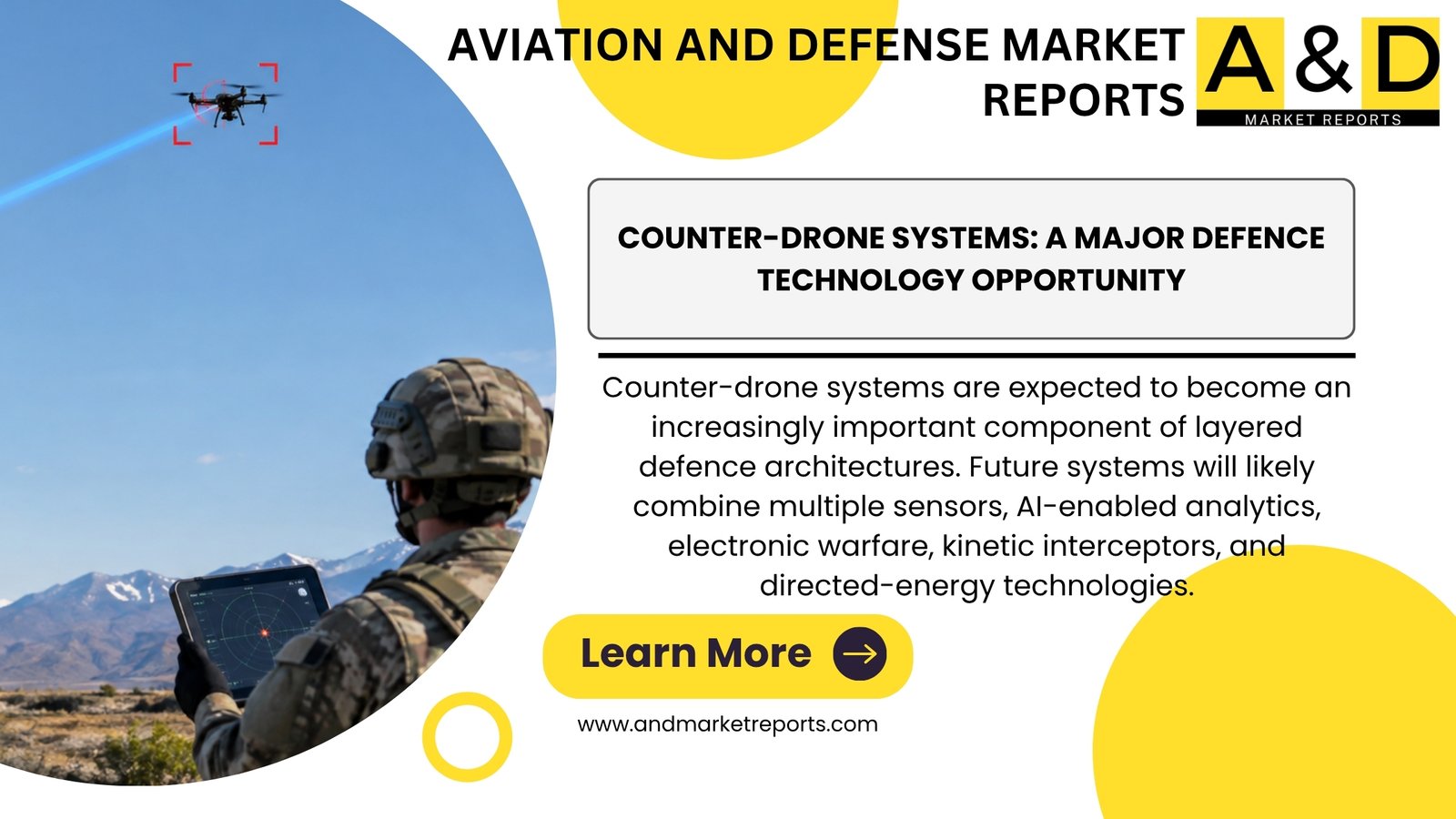
Counter-drone systems are expected to become an increasingly important component of layered defence architectures. Future systems will likely combine multiple sensors, AI-enabled analytics, electronic warfare, kinetic interceptors, and directed-energy technologies into integrated networks.
The market opportunity will extend beyond individual counter-drone products toward complete detection-to-defeat ecosystems. Defence organizations will increasingly seek solutions that can operate across different platforms and environments while integrating with existing air-defence infrastructure.
For defence companies, this creates opportunities to develop specialized technologies as well as complete C-UAS solutions. Advances in artificial intelligence, sensors, electronic warfare, directed energy, autonomous systems, and networking will continue to shape the sector.
Ultimately, the growth of unmanned aerial threats is creating a parallel requirement for increasingly sophisticated counter-drone capabilities. As drones become more autonomous, coordinated, and accessible, the ability to detect and manage these threats efficiently will become an important element of modern defence planning. Counter-drone systems are therefore emerging not simply as a niche defence technology, but as a broad and evolving opportunity spanning sensors, software, electronic warfare, effectors, and integrated defence architectures.