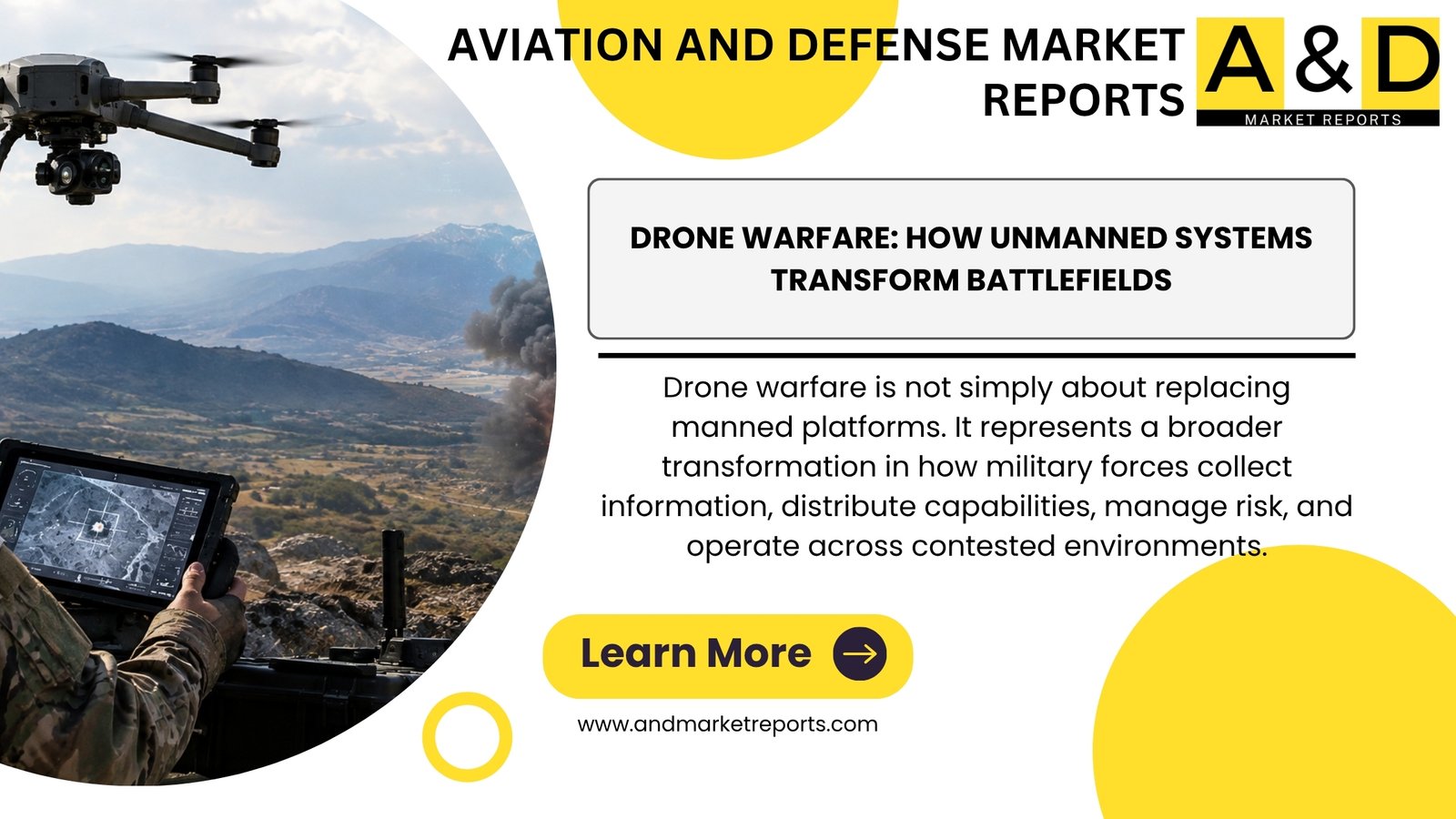

Drone warfare has emerged as one of the most significant transformations in modern military operations. Unmanned aerial systems (UAS), commonly known as drones, are changing how armed forces conduct surveillance, intelligence gathering, targeting, logistics, and combat missions. Once primarily associated with reconnaissance, drones have evolved into sophisticated platforms capable of supporting a wide range of military operations.
The rapid development of artificial intelligence, advanced sensors, satellite communications, electronic warfare, and autonomous navigation is further expanding their capabilities. At the same time, the relatively lower cost and operational flexibility of many unmanned systems are allowing military forces to deploy them in larger numbers. As a result, drones are becoming an increasingly important element of modern battlefield strategies.
Evolution of Drone Warfare
Military interest in unmanned aircraft has existed for decades, but advances in computing, communications, sensors, and propulsion have significantly accelerated their development. Early unmanned platforms were primarily used for target practice and basic reconnaissance. Over time, improvements in endurance and remote-control technology enabled drones to conduct intelligence, surveillance, and reconnaissance missions over greater distances.
The development of armed unmanned systems represented another major shift. Armed drones enabled military forces to combine surveillance and precision strike capabilities within a single platform. This reduced the time between detecting a potential target and responding to it.
More recently, smaller tactical drones have transformed battlefield operations. Compact systems can be carried and operated by relatively small military units, providing soldiers with an aerial view of their surroundings. Commercially derived technologies have also contributed to the rapid development of inexpensive small drones.
The emergence of loitering munitions has further blurred the traditional distinction between drones and precision weapons. These systems can search for or monitor an area before engaging a selected target, providing commanders with additional flexibility.
Changing the Battlefield Through Intelligence and Surveillance
One of the most important contributions of drones is their ability to provide persistent intelligence, surveillance, and reconnaissance. Aerial observation can give military commanders a better understanding of troop movements, terrain, logistics activity, and potential threats.
Small tactical drones can provide units with near-real-time views beyond their immediate line of sight. This capability can support route planning, battlefield awareness, damage assessment, and mission coordination.
Larger unmanned aircraft can remain airborne for extended periods and carry sophisticated electro-optical, infrared, radar, signals intelligence, and other sensors. These capabilities allow drones to monitor large areas and support wider intelligence networks.
The growing integration of drones with command-and-control systems is particularly important. Instead of operating as isolated platforms, unmanned systems can increasingly share information with other aircraft, ground vehicles, naval platforms, and command centers.
Precision Strike and Loitering Capabilities
Armed drones have changed the concept of precision engagement by combining persistent surveillance with strike capabilities. Instead of relying entirely on traditional manned aircraft, armed forces can use unmanned platforms for selected missions where endurance and remote operation provide advantages.
Loitering munitions represent another rapidly developing area. Unlike conventional missiles that generally follow a predetermined engagement sequence, loitering systems can remain in an area while searching for suitable targets before completing an attack.
This capability can provide forces with greater responsiveness, particularly when targets are mobile or difficult to identify in advance. However, the growing use of these systems is also raising questions about target identification, escalation, civilian protection, and the appropriate role of human decision-making.
Swarm Technology and Artificial Intelligence
The next major phase of drone warfare is expected to involve greater levels of autonomy and coordinated operations. Drone swarms consist of multiple unmanned systems that can operate together and distribute tasks across a group.
Instead of depending entirely on a single platform, swarm concepts can use multiple systems to perform surveillance, communications, electronic warfare, decoy operations, or other battlefield functions. The loss of an individual drone may therefore have less impact on the overall mission.
Artificial intelligence can support this evolution by helping drones process sensor information, identify objects, navigate complex environments, and coordinate with other platforms. AI-assisted systems may reduce the workload on human operators and enable faster processing of large volumes of battlefield data.
However, autonomous military systems also introduce significant challenges. Ensuring reliable operation, preventing unintended actions, and maintaining appropriate human oversight are important considerations as autonomy increases.
Counter-Drone Warfare
The rapid expansion of military and commercial drones has created an equally important requirement: counter-drone technology. Modern armed forces must protect personnel, vehicles, infrastructure, air bases, ships, and command centers from unmanned threats.
Counter-UAS systems can combine radar, electro-optical sensors, radio-frequency detection, electronic warfare, and other technologies to identify and track drones. Depending on the system, threats can then be disrupted, intercepted, or otherwise neutralized.
The challenge is particularly significant for small drones because they can have low radar signatures and operate at relatively low altitudes. Their affordability also means that defenders may face situations where inexpensive drones are used against significantly more expensive defensive systems.
Consequently, militaries are increasingly seeking layered counter-drone architectures that combine multiple detection and response technologies.
Impact on Military Procurement and Defense Industry
The growing importance of drones is changing defense procurement priorities. Military organizations are increasingly investing in unmanned systems alongside traditional platforms such as fighter aircraft, armored vehicles, artillery, and naval vessels.
This shift is creating opportunities for both established defense companies and smaller technology firms. Drone development increasingly involves expertise in artificial intelligence, robotics, software, communications, sensors, batteries, propulsion, and advanced materials.
Modular designs are also becoming increasingly valuable. A common unmanned platform can potentially accommodate different payloads depending on mission requirements. This enables operators to adapt systems for reconnaissance, communications, electronic warfare, logistics, or other applications.
The lower acquisition cost of some tactical drones can also encourage militaries to procure larger quantities. This represents a shift away from an exclusive focus on highly sophisticated and expensive platforms toward combinations of high-end systems and large numbers of lower-cost unmanned assets.
Challenges and Strategic Considerations
Despite their advantages, drones are not without limitations. Weather, communications disruption, electronic warfare, navigation interference, battery limitations, payload capacity, and cybersecurity can affect their effectiveness.
Electronic warfare is particularly important because many unmanned systems rely on communications and navigation signals. Adversaries can attempt to disrupt or deceive these systems, creating a continuing technological competition between drone developers and counter-drone specialists.
Cybersecurity is another concern. As drones become increasingly connected, protecting software, communications links, navigation systems, and mission data becomes essential.
There are also legal and ethical considerations surrounding autonomous and remotely operated weapons. Questions concerning accountability, human oversight, target identification, and the use of force are becoming increasingly important as technology advances.
Future Outlook
The future of drone warfare will likely involve increasingly interconnected fleets of unmanned systems rather than individual drones operating independently. Artificial intelligence, autonomous navigation, advanced sensors, secure communications, and swarm coordination are expected to shape next-generation capabilities.
Unmanned systems are also likely to expand across all military domains. In the air, drones will support surveillance, combat, electronic warfare, and logistics. On land, unmanned ground vehicles can support reconnaissance, supply missions, and other hazardous operations. At sea, unmanned surface and underwater vehicles are increasingly being developed for surveillance, mine countermeasures, anti-submarine missions, and maritime security.
The integration of manned and unmanned platforms will be another important development. Manned aircraft, armored vehicles, ships, and command centers can work alongside unmanned systems to extend sensing and operational reach.
Ultimately, drone warfare is not simply about replacing manned platforms. It represents a broader transformation in how military forces collect information, distribute capabilities, manage risk, and operate across contested environments. As unmanned technology becomes more capable and affordable, drones will remain a defining component of modern warfare and a major driver of innovation across the global defense industry.