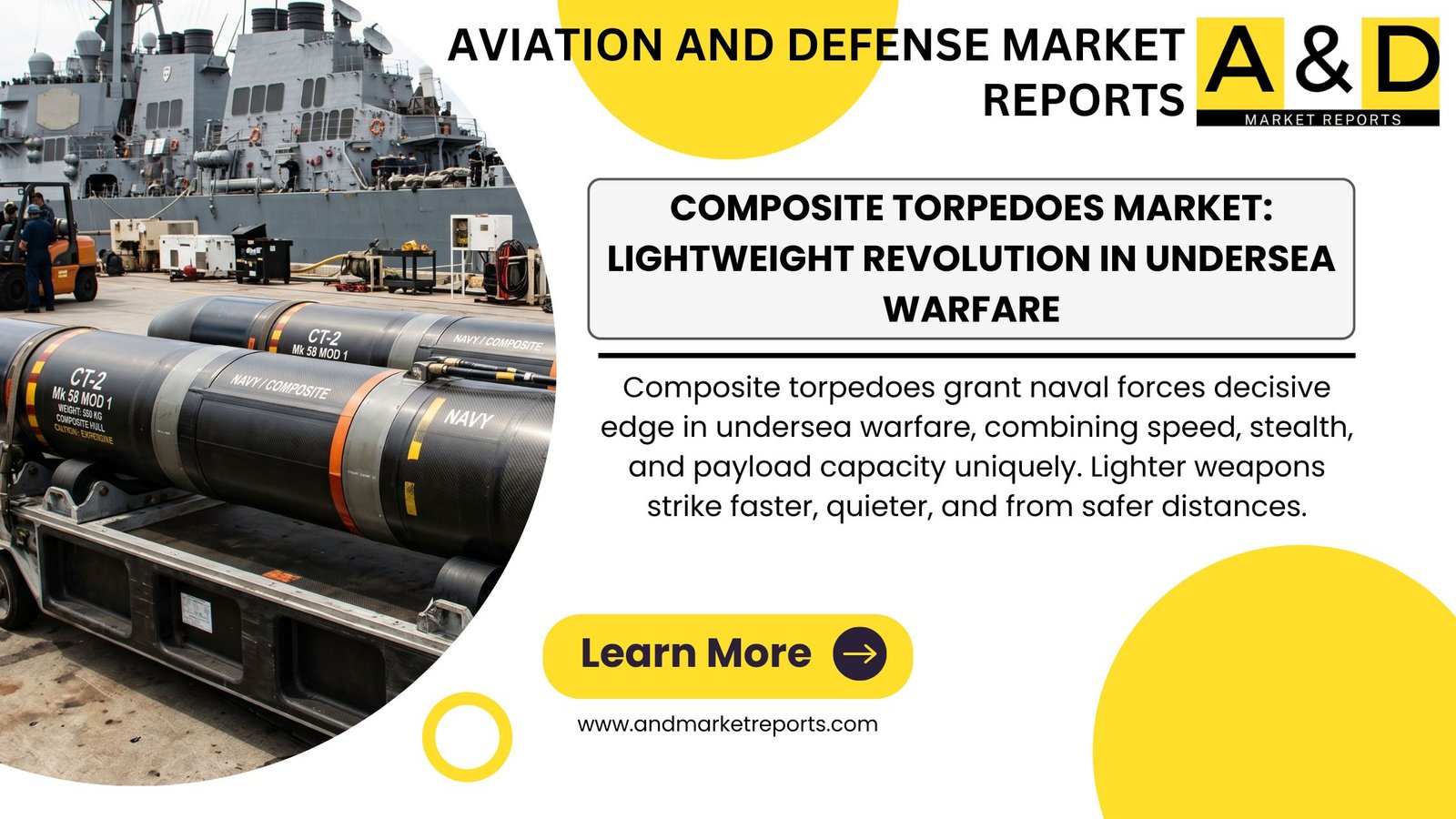

The composite torpedoes market represents a transformative shift in undersea warfare technology, where advanced materials replace traditional metal housings to create lighter, faster, and more survivable weapons. Composite torpedoes utilize fiber-reinforced polymers, carbon fiber, and advanced ceramic matrices to reduce weight while maintaining structural integrity against extreme ocean pressures. This innovation enables submarines and surface ships to carry more torpedoes, extend engagement ranges, and achieve superior acoustic performance compared to legacy steel-based systems. As naval forces worldwide prioritize anti-submarine warfare capabilities amid rising undersea tensions, the demand for composite torpedoes accelerates across global defense markets.
Material Science Driving Torpedo Evolution
Traditional torpedoes relied on aluminum or steel housings that added significant weight, limiting payload capacity and reducing maneuverability. Composite materials revolutionize this paradigm by offering exceptional strength-to-weight ratios. Carbon fiber composites provide rigidity comparable to metals while weighing up to fifty percent less. Fiber-reinforced polymers resist corrosion from saltwater environments, eliminating the maintenance burdens that plague metal housings.
Advanced ceramic matrices protect sensitive electronics from shock waves generated by nearby explosions. These materials also dampen vibrations, reducing the torpedo’s acoustic signature and making detection by enemy sonar more difficult. The result is a weapon that moves faster, turns sharper, and remains stealthier throughout its mission profile.
Manufacturing processes have evolved to handle these complex materials. Automated fiber placement robots lay composite layers precisely, ensuring uniform strength distribution. Microwave curing accelerates polymer hardening, slashing production timelines. Non-destructive testing verifies integrity without damaging delicate components.
Performance Advantages Over Legacy Systems
Weight reduction delivers immediate tactical benefits. Lighter torpedoes accelerate faster, reaching critical speeds before enemy submarines can react. Reduced mass enables tighter turning radii, allowing pursuit of agile targets through complex underwater terrain. Submarines can store more composite torpedoes in confined hull spaces, extending operational endurance without sacrificing payload.
Acoustic stealth proves equally critical. Composite materials absorb vibration energy rather than reflecting it, masking the torpedo’s passage through water. quieter propulsion systems integrate seamlessly with lightweight housings, creating weapons that approach targets undetected. Enemy sonar systems struggle to distinguish composite torpedoes from ambient ocean noise, buying precious seconds for final approach.
Range extension follows naturally from efficiency gains. Less drag means propellers consume less energy per mile, stretching battery life. Extended ranges allow launch platforms to engage targets from safer distances, reducing vulnerability to counterattack.
Naval Applications Across platforms
Surface ships increasingly mandate composite torpedoes for anti-submarine warfare大队。Destroyers and frigates mount vertical launch systems housing composite weapons ready for immediate deployment. These platforms patrol critical sea lanes, deterring submarine incursions into protected waters.
Submarines benefit most dramatically from weight savings. Nuclear attack submarines carry dozens of composite torpedoes alongside cruise missiles, maintaining flexible strike options. Conventional submarines with limited battery capacity prioritize lightweight weapons that maximize engagement opportunities per dive.
Special operations vessels deploy compact composite torpedoes for covert missions. These weapons fit into small payload tubes, enabling surprise attacks against high-value targets. Coastal defense boats mount lightweight torpedoes for littoral patrols, protecting harbors from submarine threats.
Market Drivers Fueling Expansion
Geopolitical tensions in maritime hotspots drive naval modernization programs worldwide. Nations contesting territorial waters invest heavily in anti-submarine capabilities, recognizing submarines as asymmetric threats. Composite torpedoes offer cost-effective upgrades to existing fleets, extending service life without complete platform replacement.
Budget constraints favor composite solutions that deliver superior performance per dollar. Lighter weapons reduce logistical burdens, requiring fewer support vessels and smaller storage facilities. Maintenance costs drop as corrosion-resistant materials eliminate frequent hull repairs.
Technological spillovers from aerospace and automotive sectors accelerate composite adoption. Carbon fiber production scales commercially, lowering material costs. Manufacturing expertise transfers from jet fuselages to torpedo housings, refining quality control processes.
Technological Innovations Transforming Warfare
Directed energy systems emerging for torpedo defense require lightweight countermeasures. Composite torpedoes integrate electromagnetic pulse generators that jam enemy sonar, creating silence bubbles around launch platforms. Laser dazzlers mounted on composite housements blind optical sensors without adding weight penalties.
Artificial intelligence enhances target selection. Autonomous algorithms analyze sonar returns, identifying submarine classes and predicting evasion patterns. Machine learning optimizes attack trajectories, adjusting for water temperature, currents, and depth variations in real-time.
Swarm tactics leverage composite weight savings. Multiple lightweight torpedoes coordinate attacks, overwhelming enemy defenses through saturation. Distributed sensing networks share target data, enabling coordinated strikes from multiple launch points.
Operational Challenges Conquered
Extreme ocean pressures test composite integrity at depths exceeding thousands of meters. Layered armor designs distribute stress evenly, preventing catastrophic failure. Redundant sealing systems protect electronics from water intrusion, ensuring mission reliability.
Thermal management remains critical. High-power motors generate heat that composite materials must dissipate efficiently. Ceramic coatings reflect infrared radiation, masking thermal signatures from enemy sensors. Active cooling systems circulate coolant through internal channels, maintaining optimal temperatures.
Supply chain vulnerabilities affect composite production. Specialized fibers require rare raw materials, creating bottlenecks during surges in demand. Strategic stockpiles buffer against disruptions, ensuring continuous production schedules.
Leading Innovators Shaping the Market
Major defense contractors dominate composite torpedo development. Lockheed Martin pioneers carbon fiber housings for next-generation heavy torpedoes. Raytheon integrates AI guidance systems with lightweight composites for precision strikes.
Atlantic Research manufactures fiber-reinforced polymer bodies for medium-range weapons. Voith Silicones produces ceramic matrix composites shielding electronics from shock. Strategies blend proprietary materials with open architectures, enabling rapid upgrades.
Joint ventures partner material scientists with weapon designers, accelerating innovation cycles. Certification programs validate composite performance under extreme conditions, building confidence among naval buyers.
Regional Dynamics and Capabilities
North America leads composite torpedo innovation with advanced programs integrating AI and swarm tactics. Europe collaborates through multinational initiatives standardizing interfaces across allied navies. Asia-Pacific nations scale domestic production amid maritime tensions and island disputes.
Middle Eastern forces prioritize desert-hardened systems resistant to salt corrosion. African militaries focus on lightweight, affordable solutions for coastal patrols. Latin American countries emphasize mobility and rapid deployment capabilities for anti-smuggling operations.
Sustainability Embedded in Design
Composite materials reduce environmental impact by eliminating toxic metal coatings. Recycling programs recover carbon fiber from retired torpedoes, repurposing it for new units. Energy-efficient manufacturing processes slash carbon footprints.
Predictive maintenance algorithms minimize spare parts waste. Digital twins simulate lifetimes pre-build, optimizing material usage. Additive manufacturing prints custom components on demand, reducing inventory overhead.
Emerging Frontiers Unleashed
Quantum sensors detect submarines through magnetic anomalies, guiding composite torpedoes with unprecedented accuracy. Hypersonic underwater vehicles outpace traditional defenses, requiring lightweight countermeasures. Bio-inspired designs mimic shark movements for silent propulsion.
Neural interfaces fuse operator intuition with machine precision, enabling intuitive command of swarm tactics. Self-healing composites repair micro-cracks autonomously, extending service life indefinitely.
Unmatched Undersea Dominance
Composite torpedoes grant naval forces decisive edge in undersea warfare, combining speed, stealth, and payload capacity uniquely. Lighter weapons strike faster, quieter, and from safer distances.
They dominate the depth decisively.
Markets propel this material revolution forward, composites reshaping undersea combat. From submarines to surface ships, composite torpedoes secure ocean supremacy. Embrace the lightness—victory dives deep.