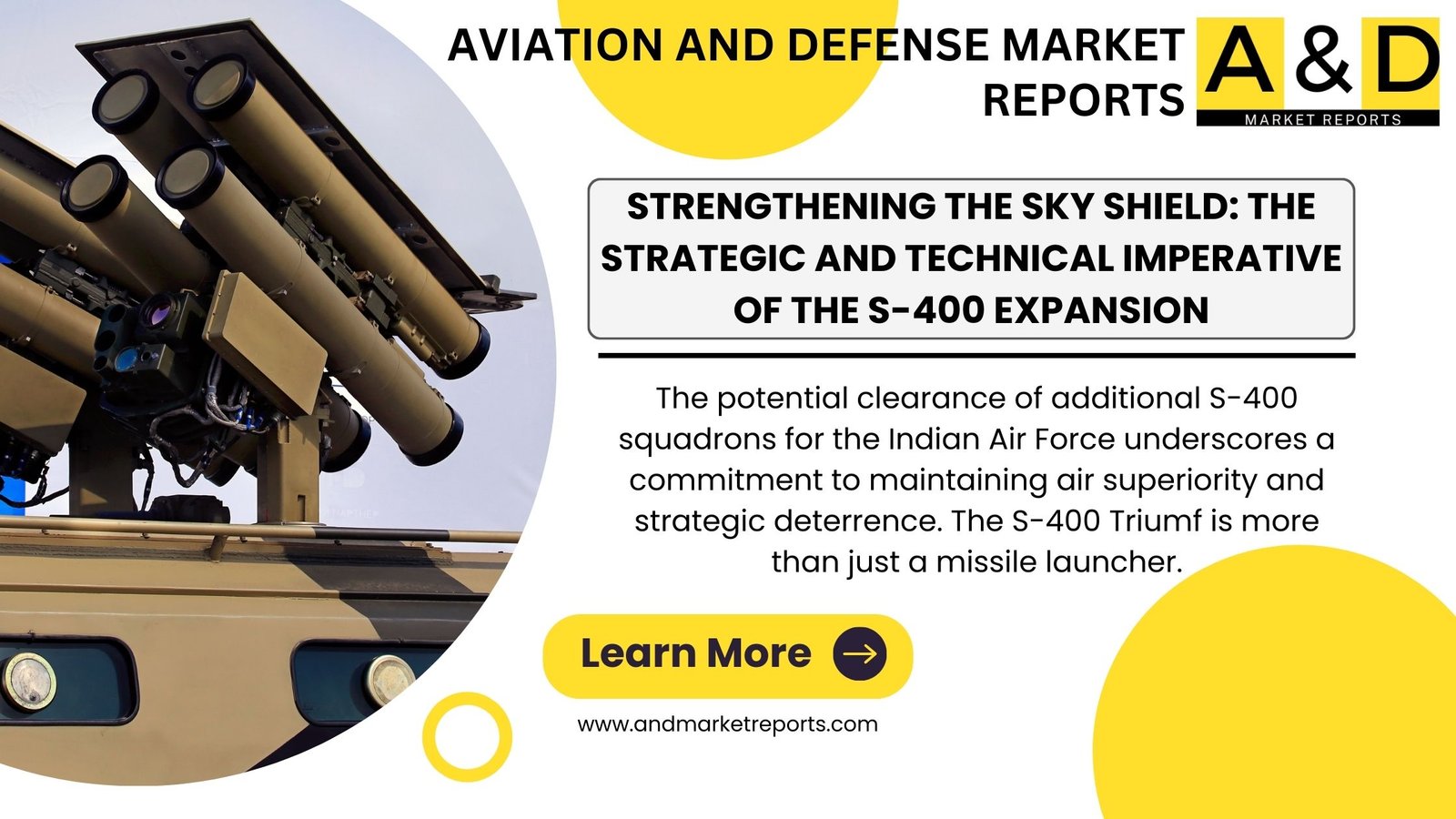

The recent indication that the Ministry of Defence (MoD) is poised to clear the Indian Air Force’s (IAF) proposal for the procurement of additional S-400 Triumf squadrons marks a significant chapter in the modernization of India’s air defense architecture. While the initial acquisition established a foothold for long-range surface-to-air missile (SAM) capabilities within the region, an expansion of this fleet represents a deepening of the strategic air defense umbrella. This move is not merely about increasing inventory; it is about creating a dense, layered, and impenetrable grid of airspace protection. To understand the magnitude of this decision, one must look beyond the headlines and delve into the technical prowess of the platform, its operational mechanics, and how it compares to similar systems deployed globally. This blog explores the S-400 Triumf as a weapon system, its working principles, and its place in the pantheon of global air defense.
The S-400 Triumf: An Overview of the Platform
The S-400 Triumf, known by its NATO reporting name as the SA-21 Growler, is a mobile, surface-to-air missile system developed by the Almaz-Antey design bureau in Russia. It was designed to succeed the S-300 family of systems, offering superior range, mobility, and engagement capabilities. The system entered service in 2007 and has since become one of the most sought-after air defense solutions in the world.
The “400” in its designation refers to its generation of technology, signifying a leap forward in radar processing and missile guidance compared to its predecessors. The system is designed to be highly mobile, mounted on transporter erector launcher (TEL) vehicles, which allows it to relocate quickly after firing to avoid counter-battery fire. This mobility is crucial for survivability in a high-intensity conflict environment. The S-400 is not a single weapon but a complex system of systems, integrating various radar types, command posts, and launch vehicles into a cohesive network. Its primary design philosophy revolves around the concept of “area denial,” making vast swathes of airspace hostile to enemy aircraft, drones, and missiles.
Working Principle and System Architecture
To appreciate the capability of the S-400, one must understand its working principle, which relies on a sophisticated network of sensors and shooters. The system operates on the fundamental military doctrine of detection, tracking, engagement, and destruction. However, the S-400 executes this doctrine with a level of automation and speed that minimizes human reaction time.
The Radar Suite
The eyes of the S-400 are its radars. The system typically employs a multi-radar architecture to ensure redundancy and comprehensive coverage.
- Acquisition Radars: These are long-range surveillance radars, often operating in the VHF or UHF bands. Their primary role is to scan the horizon and detect incoming threats at distances exceeding 600 kilometers. VHF radars are particularly notable for their ability to detect low-observable or “stealth” aircraft, as the longer wavelength can resonate with the physical structures of stealth designs, revealing their presence even if fire-control radars cannot lock onto them immediately.
- Engagement Radars: Once a threat is detected by the acquisition radar, the data is passed to the engagement radars, which operate in higher frequency bands (such as X-band). These radars provide the precise tracking data necessary to guide the missiles. They can track multiple targets simultaneously, maintaining a lock on dozens of aircraft or missiles while guiding interceptors toward them.
- Low-Altitude Detection: Specialized radars are included to detect threats skimming the terrain or flying at very low altitudes, countering cruise missiles that attempt to hide in ground clutter.
Command and Control
The brain of the operation is the Command Post. This vehicle receives data from all associated radars within the battery. It fuses this information to create a single, comprehensive air picture. The command post evaluates threats based on trajectory, speed, and type, automatically prioritizing targets. It then assigns the most appropriate launcher and missile type to engage the specific threat. This centralization allows one battery to control multiple launch sites, creating a flexible defense zone.
The Engagement Sequence
When a threat is confirmed, the system initiates the firing sequence. The launcher vehicle elevates the missile canister, and the missile is launched using a cold-launch or hot-launch system depending on the specific missile variant. Once airborne, the missile does not necessarily rely on its own seeker immediately. Instead, it often utilizes a “Track-Via-Missile” (TVM) guidance system. In this mode, the ground radar tracks both the target and the missile, sending correction commands to the missile via a data link. This allows for mid-course corrections, ensuring the interceptor stays on the optimal collision course. In the terminal phase, the missile may activate its own active radar seeker for the final kill, ensuring precision even if the ground radar link is disrupted.
Missile Variants and Engagement Capabilities
One of the S-400’s greatest strengths is its ability to fire different types of missiles from the same launcher. This modularity allows the system to engage a wide spectrum of targets, from high-altitude ballistic missiles to low-flying drones.
- The 40N6 Missile: This is the long-range interceptor of the family. Capable of reaching ranges up to 400 kilometers, it is designed to engage high-value assets such as AWACS (Airborne Warning and Control Systems), tankers, and strategic bombers before they can launch their own standoff weapons. It operates at high altitudes, covering the upper layers of the airspace.
- The 48N6 Missile: A medium-to-long-range missile that serves as the workhorse of the system. It is highly effective against tactical aircraft and cruise missiles. Its speed and maneuverability allow it to engage high-G targets that are attempting to evade interception.
- The 9M96 Series: These are smaller, shorter-range missiles designed for point defense. They are highly agile and are intended to engage threats that have penetrated the outer layers of defense. They are particularly effective against precision-guided munitions and tactical missiles.
This layered missile approach ensures that an enemy aircraft faces multiple engagement zones. An attacker might evade the outer ring of 40N6 missiles, only to be engaged by the 48N6, and finally face the 9M96 if they attempt to breach the core protected area.
Strategic Significance for the Indian Air Force
For the Indian Air Force, the integration of the S-400 is about creating a strategic buffer. The geopolitical landscape of the region necessitates a robust air defense capability that can monitor and control vast stretches of airspace along the northern borders. The addition of more squadrons enhances the depth of this defense.
Layered Air Defense
Modern air warfare is not about a single line of defense but a layered network. The S-400 forms the outermost layer of India’s Integrated Air Command and Control System (IACCS). By pushing the engagement zone hundreds of kilometers away from the border, the IAF ensures that hostile aircraft cannot easily position themselves to launch attacks on strategic assets, airbases, or population centers. This “stand-off” capability forces adversaries to operate from greater distances, reducing the accuracy and payload effectiveness of their offensive sorties.
Deterrence and Denial
The presence of the S-400 acts as a potent deterrent. Knowing that airspace is monitored by long-range radars capable of detecting stealth aircraft and that any intrusion will be met with long-range interceptors changes the calculus of potential aggressors. It denies the enemy the freedom of operation in contested airspace. For the IAF, this means their offensive fighters can operate with greater confidence, knowing that the rear areas and critical infrastructure are shielded by a reliable umbrella.
Network Integration
The S-400 is not designed to operate in isolation. In the Indian context, it is integrated with indigenous systems and other foreign assets. Data from the S-400 radars can be fed into the broader IAF network, enhancing the situational awareness of fighter pilots and other air defense units. This interoperability ensures that the S-400 enhances the effectiveness of the entire force, rather than functioning as a standalone silo.
Global Counterparts and Similar Platforms
To fully grasp the capability of the S-400, it is essential to compare it with similar long-range air defense systems used by other nations. While every system has unique design philosophies, they share the common goal of denying airspace to the enemy.
The Patriot System (United States)
The MIM-104 Patriot is the primary air defense system of the United States and many NATO allies. Like the S-400, it is a mobile SAM system. The Patriot PAC-3 variant is renowned for its hit-to-kill technology, where the missile physically collides with the target rather than exploding near it. While the S-400 generally boasts a longer maximum engagement range for aerodynamic targets, the Patriot is highly regarded for its reliability and its specific optimization against tactical ballistic missiles. The radar technology in the Patriot, particularly the AN/MPQ-65, is sophisticated, but the S-400’s use of multiple radar frequencies gives it an edge in anti-stealth detection.
THAAD (United States)
The Terminal High Altitude Area Defense (THAAD) system is designed specifically for intercepting short and medium-range ballistic missiles during their terminal phase. Unlike the S-400, which is a dual-purpose system capable of engaging both aircraft and missiles, THAAD is specialized for exo-atmospheric and high endo-atmospheric ballistic missile defense. It does not engage aircraft. In a comprehensive air defense network, THAAD and S-400 would complement each other, with THAAD handling high-altitude ballistic threats and S-400 handling the mixed threat environment of aircraft and cruise missiles.
SAMP/T (Europe)
The Surface-to-Air Missile Platform/Terrain (SAMP/T) is a European system developed by France and Italy. It utilizes the Aster 30 missile. The SAMP/T is highly mobile and features advanced radar systems like the ARABEL. It is comparable to the S-400 in terms of mobility and network-centric warfare capabilities. However, the S-400 typically offers a wider variety of missile ranges within a single battery configuration, allowing for more flexible engagement envelopes without needing different system types.
Barak-8 (Israel/India)
The Barak-8 is a long-range surface-to-air missile developed jointly by India and Israel. While it serves a similar role in protecting assets from aerial threats, it is generally categorized as a medium-to-long-range system compared to the very-long-range classification of the S-400. The Barak-8 is crucial for point defense of naval assets and critical land infrastructure. In the Indian inventory, the Barak-8 and S-400 work in tandem, with the Barak-8 providing a closer-in defense layer while the S-400 manages the distant perimeter.
Operational Deployment and Tactical Doctrine
The deployment of the S-400 follows specific tactical doctrines designed to maximize its survivability and lethality. A typical S-400 battalion is a self-sufficient unit. It includes the command post, radar vehicles, launcher vehicles, and support vehicles for maintenance and reloading.
Dispersal and Mobility
A key tactical advantage is the ability to disperse. The launchers do not need to be co-located with the radars. The radars can be positioned in advantageous terrain to maximize line-of-sight, while the launchers can be hidden in defilade positions to protect them from direct fire. The system can be packed up and moved within minutes. This “shoot and scoot” capability is vital. In modern warfare, once a radar emits a signal, enemy anti-radiation missiles can home in on that source. By moving the battery immediately after a launch, the S-400 minimizes the window of vulnerability.
Electronic Warfare Resistance
The S-400 is designed with significant electronic counter-countermeasure (ECCM) capabilities. The radars employ frequency agility, meaning they can rapidly change their operating frequency to avoid jamming. The system can also operate in passive modes, receiving data from external sources without emitting its own radar signals, thereby remaining invisible to enemy electronic support measures until the moment of engagement.
Logistics and Sustainment
Operationally, the system requires a steady supply chain for missile reloads. The transporter loader vehicles are designed to reload the launch tubes in the field, allowing the battery to return to combat status quickly after expending its initial load. This sustainability ensures that the air defense umbrella remains intact over prolonged periods of conflict.
Conclusion
The potential clearance of additional S-400 squadrons for the Indian Air Force underscores a commitment to maintaining air superiority and strategic deterrence. The S-400 Triumf is more than just a missile launcher; it is a complex, networked ecosystem of sensors and interceptors designed to dominate the airspace. Its ability to engage a diverse range of targets, from stealth aircraft to ballistic missiles, makes it a cornerstone of modern air defense.
When viewed alongside global counterparts like the Patriot and THAAD, the S-400 stands out for its versatility and range. For India, the expansion of this fleet means a deeper, more resilient defense grid. It ensures that the IAF can operate with the confidence that its strategic assets are protected by one of the most capable air defense systems in existence. As aerial threats evolve, becoming faster and more elusive, the need for such robust, long-range interception capabilities becomes paramount. The S-400 represents a critical layer in the shield that protects national sovereignty, ensuring that the skies remain secure against any potential aggression. The focus remains firmly on operational readiness and technical superiority, securing the nation’s airspace for the future.